









More from our Paris trip: the Seine cruise · the Louvre · the metro guide
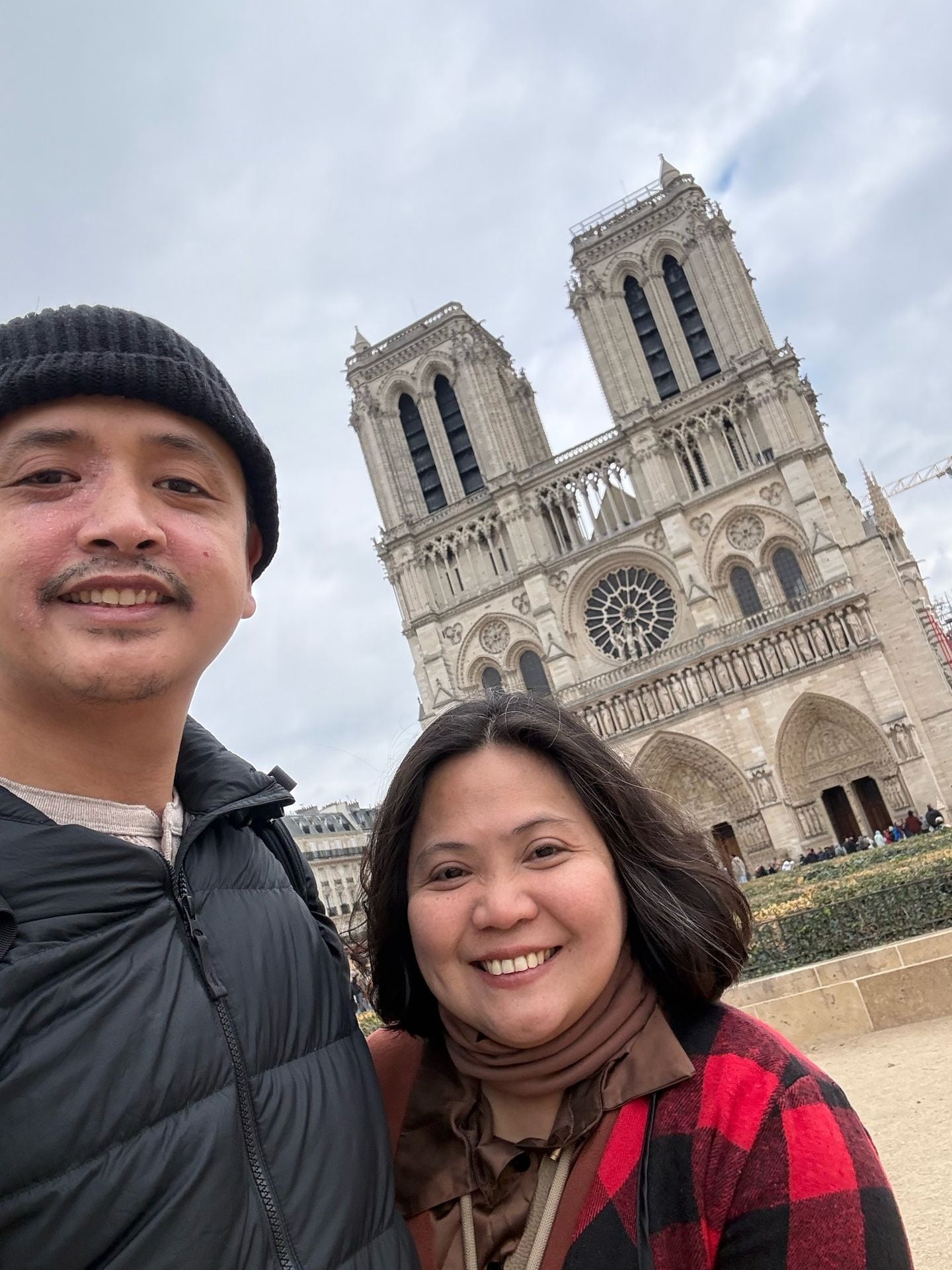
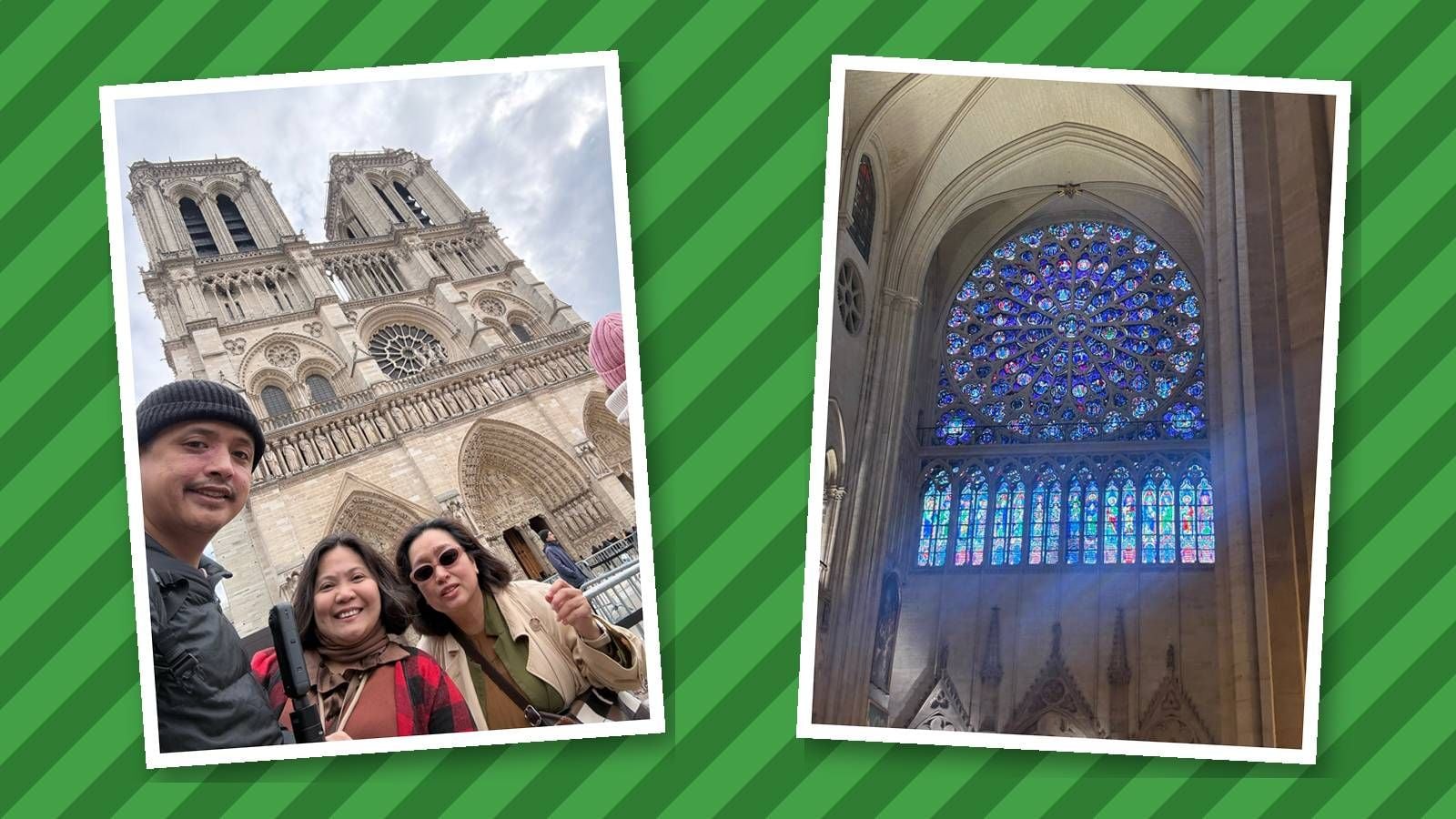
The last time we saw Notre-Dame, we were floating past it on the Seine, heads tilted back to look at the new spire. This time we walked right up to the front door. First things first: the selfie. Beanie on, scarf on, those famous twin towers behind us.
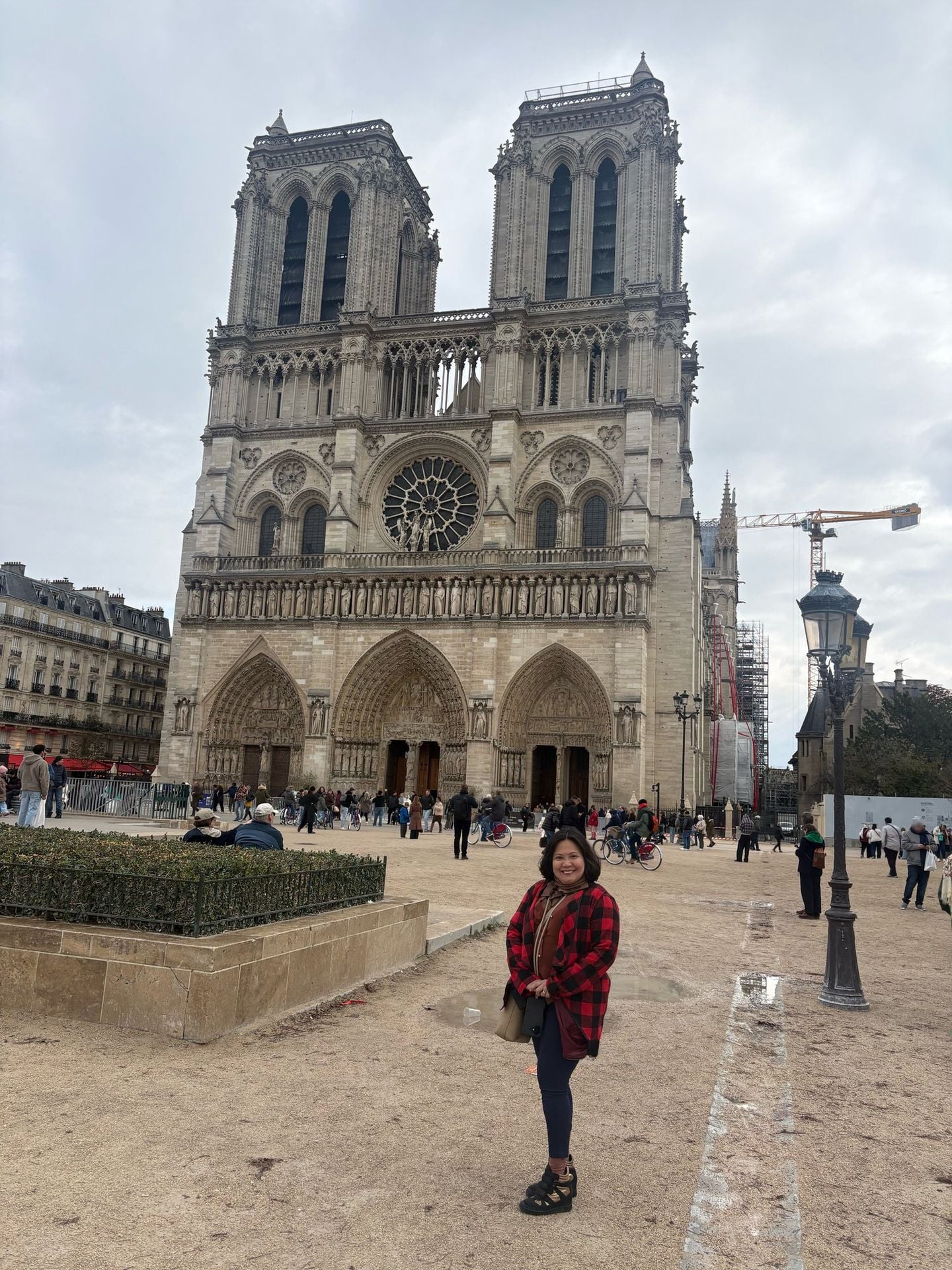
Dimple got her solo shot on the big square out front, with the whole façade lined up behind her. Grey autumn sky again. By now we’re used to it, and honestly, the pale stone looks good against it.
Fun fact: the square where France’s roads begin
Somewhere on this square is a little brass medallion with a compass rose called Point Zéro. It’s the spot road distances from Paris to other French cities are measured from. The old one was damaged in the 2019 fire, so the city made an exact copy and put it back on 1 July 2025. Legend says if you step on it, you’ll come back to Paris one day.
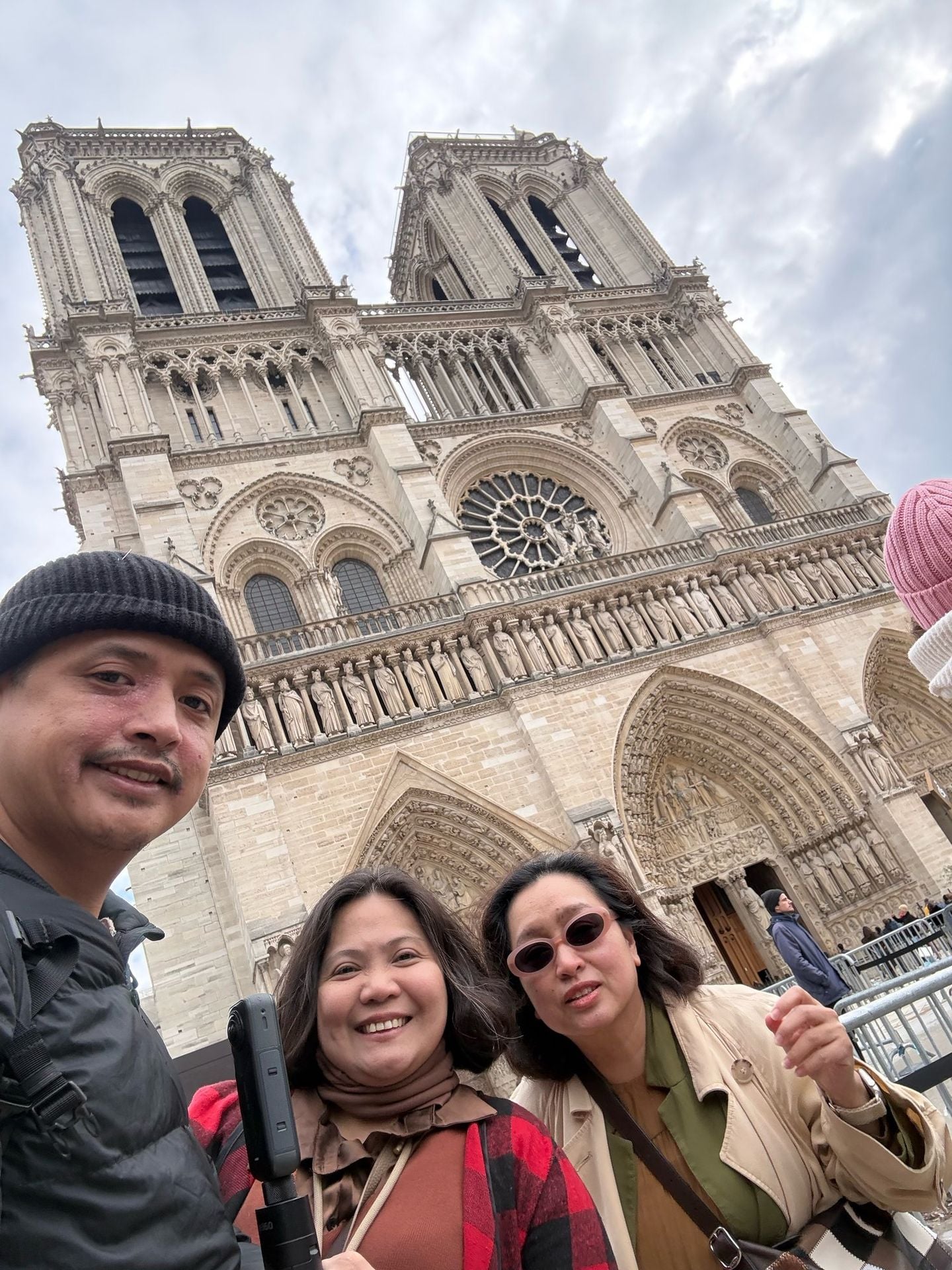
Then Tin squeezed in, sunglasses and all, and we had the family photo.
Back from the fire
On 15 April 2019, the world watched Notre-Dame burn. The spire fell and most of the old wooden roof was lost, but the stone vaults held and the cathedral’s great medieval rose windows came through. After years of restoration, Notre-Dame reopened to visitors on 8 December 2024. So walking in felt a little special. Not just “we’re in Paris”, but “we’re in Paris and this place is open again”.
History bite: how old is this place?
Really old. The first stone of Notre-Dame was laid in 1163, in the presence of Pope Alexander III, under Bishop Maurice de Sully. An even older cathedral, Saint-Étienne, was taken down to make room for it.
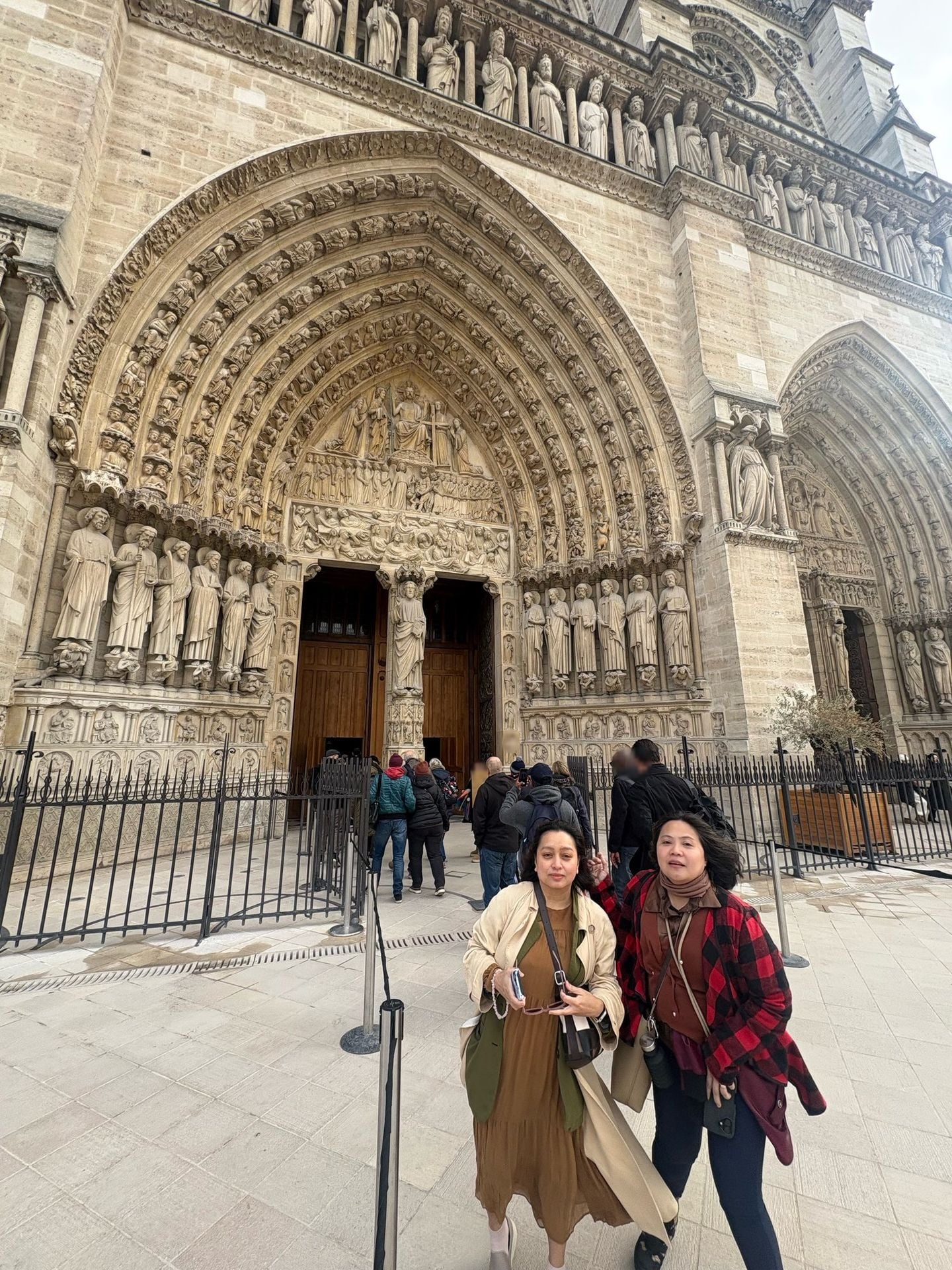
Tin and Dimple at the entrance, under one of the carved portals. Look above them: every bit of that arch is covered in little stone figures.
Did you know? A Bible made of stone
The front of Notre-Dame has three portals: the Last Judgment in the middle, the Virgin on the left and Saint Anne on the right. All those carved figures had a job. They helped people who couldn’t read the Bible follow its stories in pictures.
Inside: light, stone and candles
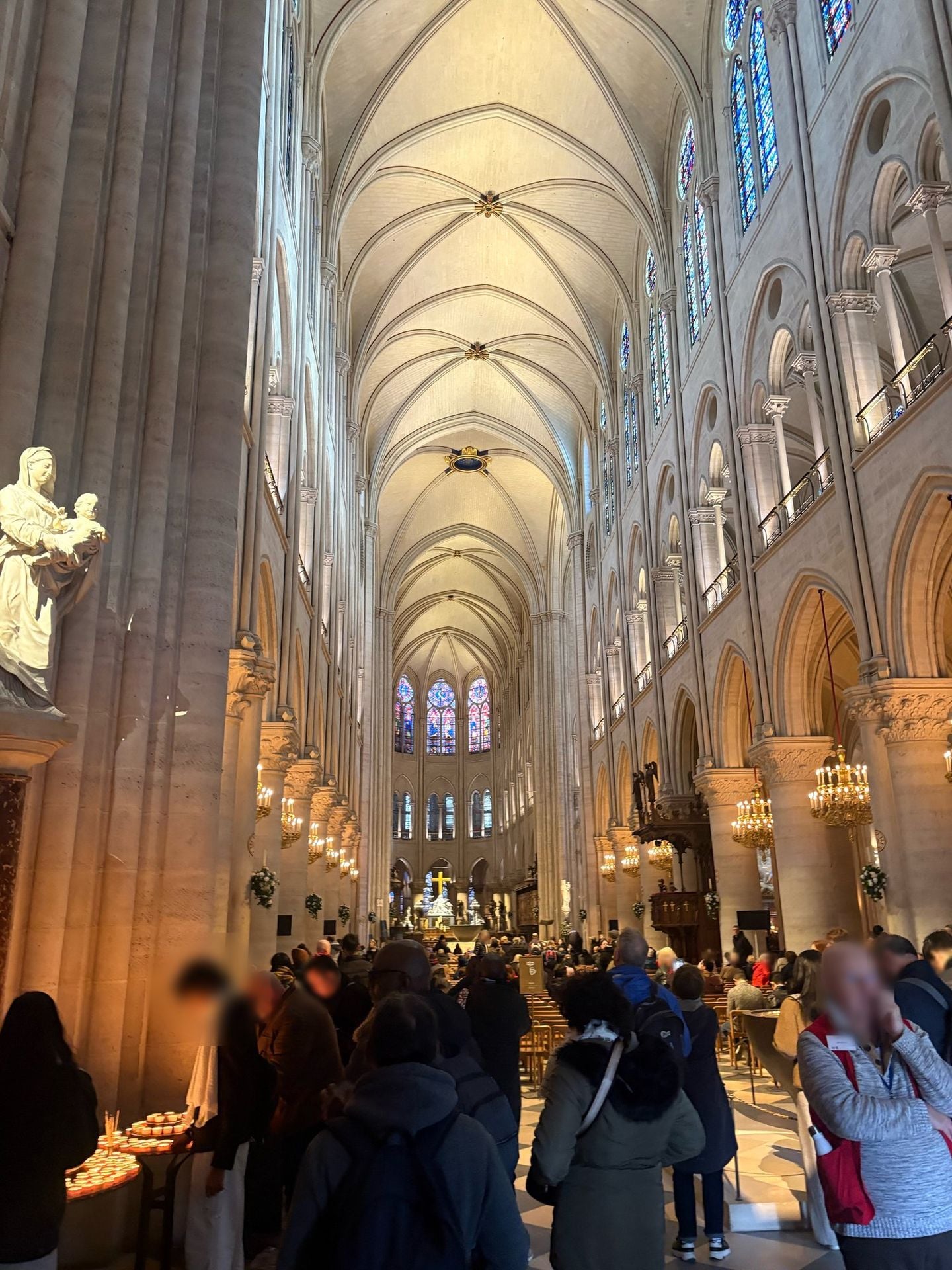
The first thing that hits you inside is how bright it is. The stone has been cleaned, and it’s pale and golden now, all the way up to the ceiling. We just stood at the back of the nave for a moment and looked.
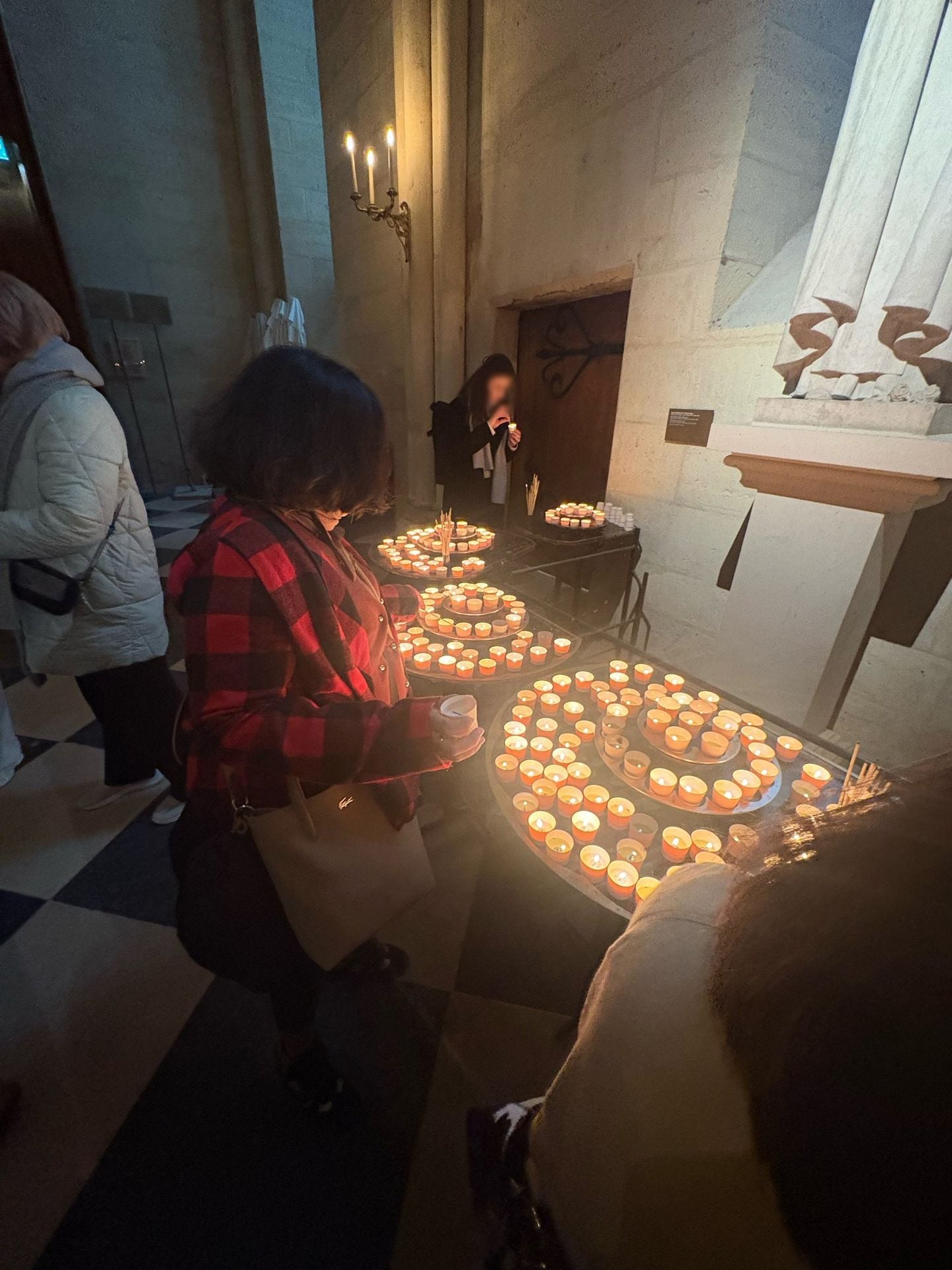
Dimple stopped at the candles, of course. Rows and rows of little flames, glowing in a dark corner. It’s one of those quiet moments in the middle of a busy cathedral.
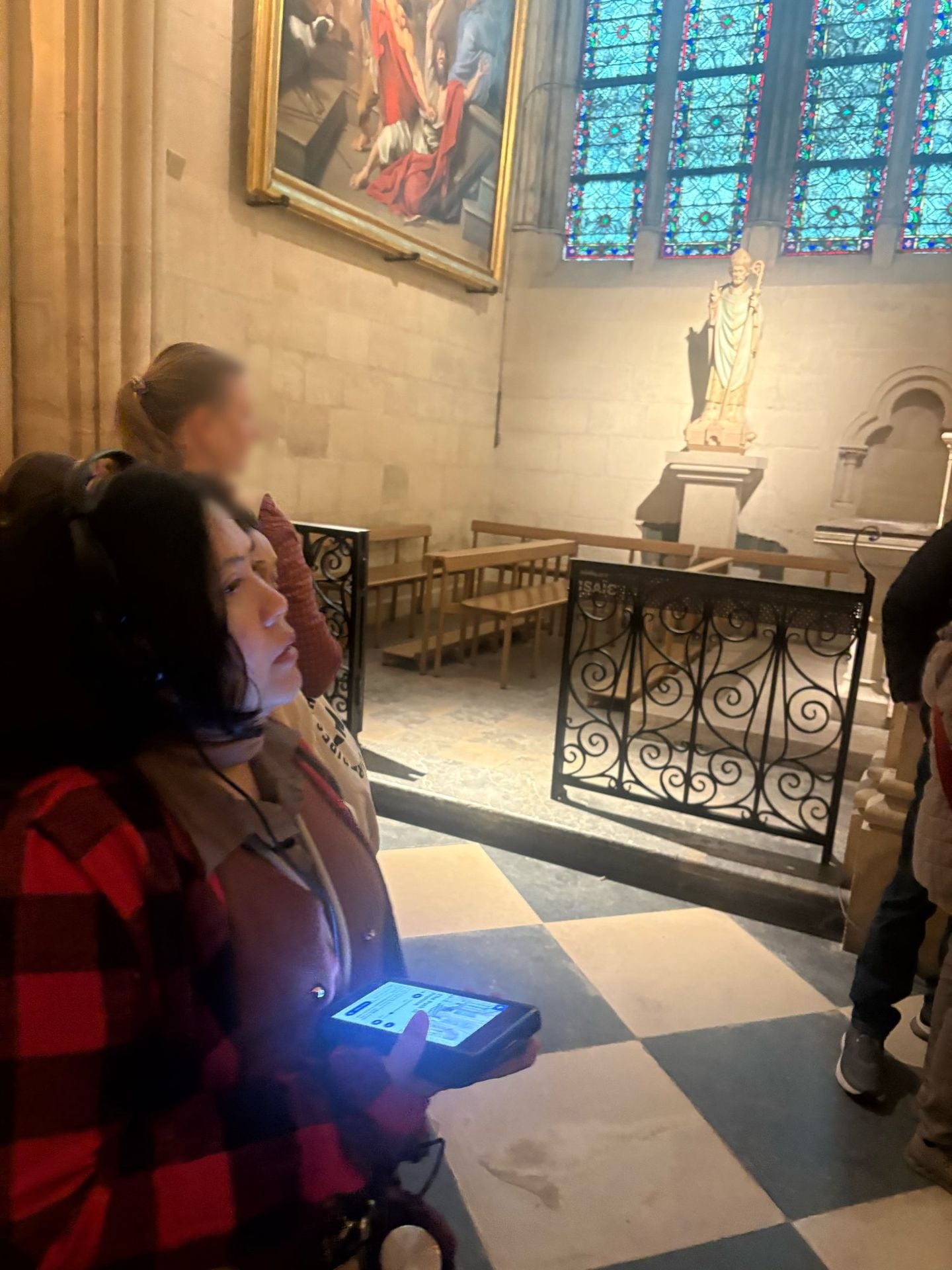
Along the sides there are chapels, each a little world of its own. This one had a statue of a bishop, a big painting and blue stained glass glowing above.
The rose window
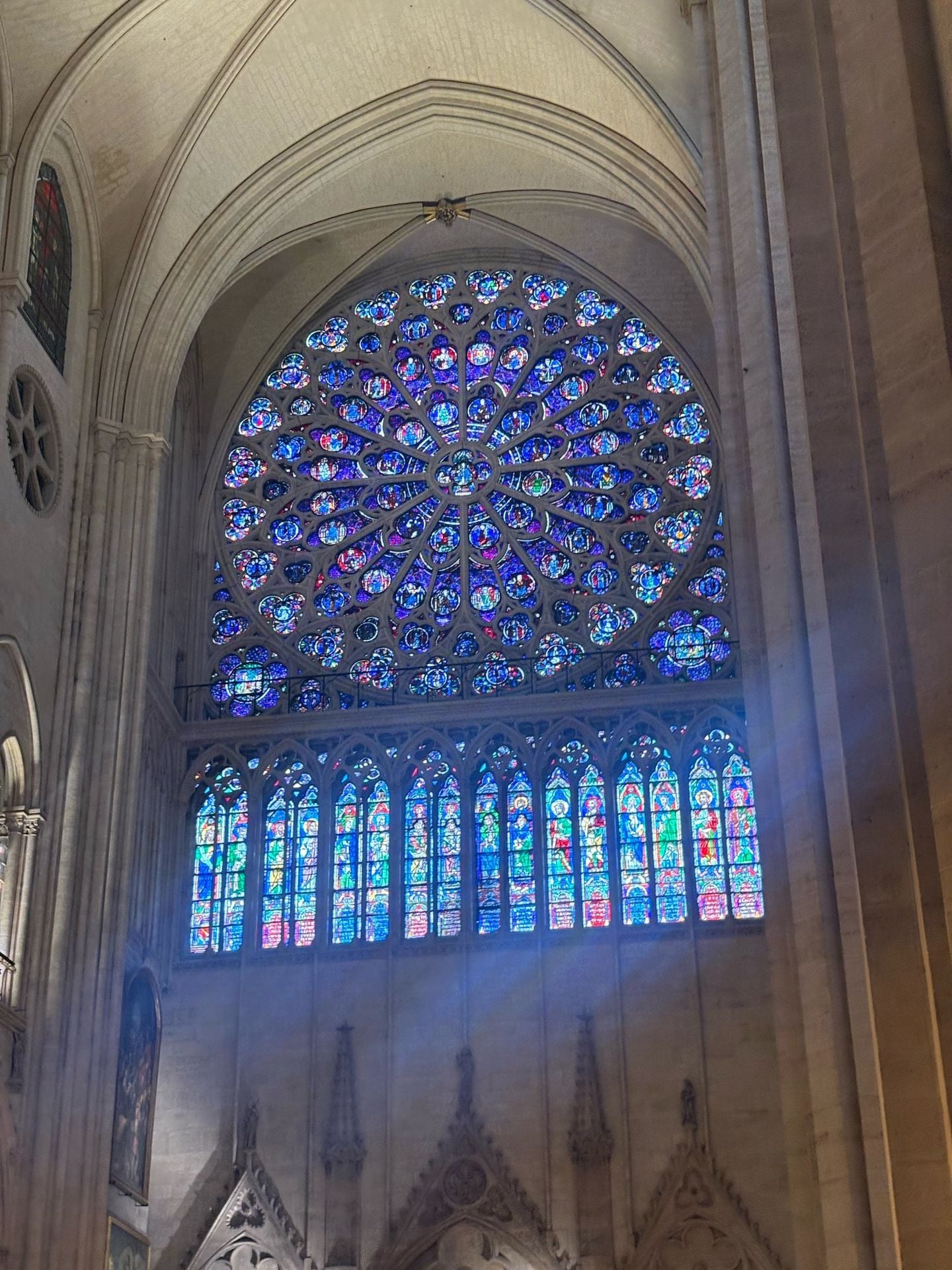
And then this. If you only look up once in Notre-Dame, make it here. The rose window glows blue and violet, like a giant kaleidoscope. Hard to believe it came through a fire.
What is a rose window, anyway?
It’s a big round window, decorated with stone tracery and filled with stained glass, a signature of Gothic churches. They usually sit at the west end and at the ends of the transept, the “arms” of a cross-shaped church. France is where they became most popular, and Notre-Dame’s 13th-century roses are among the most famous. Notre-Dame has three of them (west, north and south), and they’re the only medieval stained glass still in place in the cathedral.
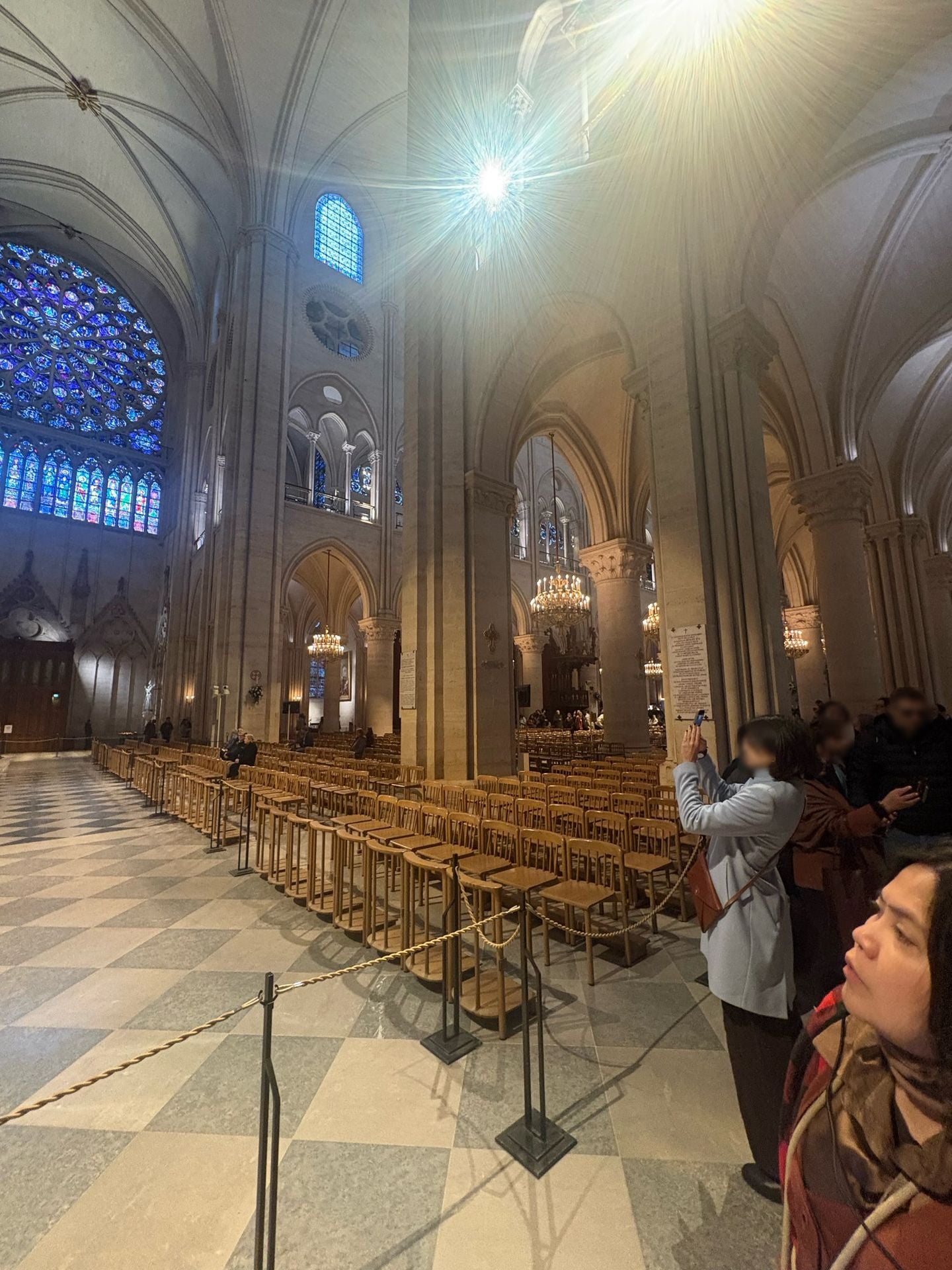
Here’s the bigger picture from the transept, with Dimple looking up in the corner. Everyone around us was doing the same thing: phones up, mouths open.
Rose window trivia
The north rose shows the Virgin Mary surrounded by figures from the Old Testament. The south rose was a gift from King Saint Louis. In the 19th century, the architect Viollet-le-Duc found the stone around the south rose was sinking, so he strengthened the wall and turned the whole rose slightly on its axis. Yes, he rotated a giant window.
The new altar
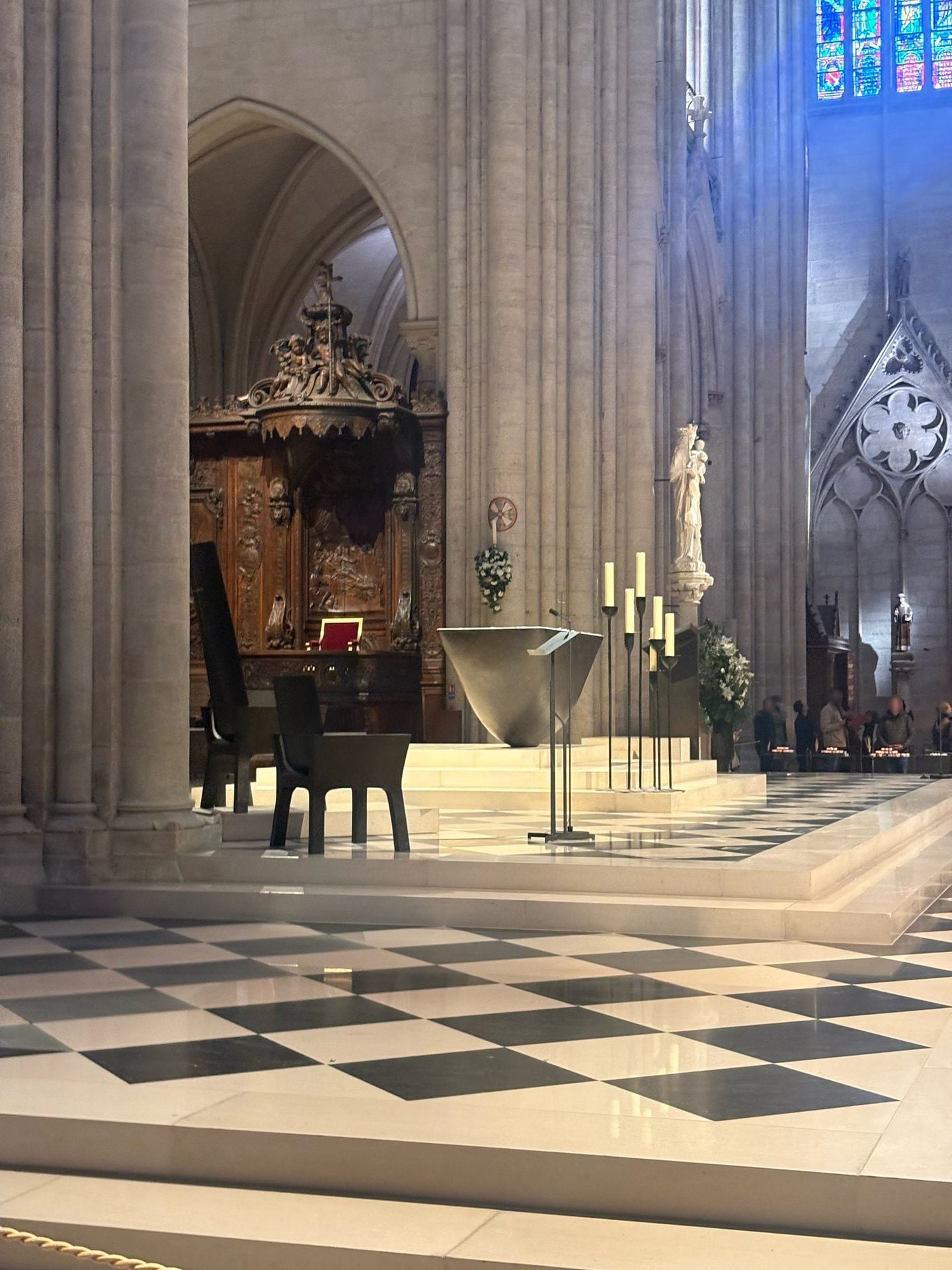
At the crossing is the new altar, made for the reopening. It’s a simple, bowl-shaped piece of bronze by the designer Guillaume Bardet, and it’s very different from everything around it. Some old, some new, both glowing.
Fun fact: the new altar’s secret size
The Archbishop of Paris, Laurent Ulrich, chose Guillaume Bardet in June 2023 to make the cathedral’s main new liturgical furniture, all in bronze. The altar is the same size as the old altar, to the centimetre. The archbishop said it seems to rise from the floor like a block of stone that flattens into a table. The pieces were cast at a foundry in Crest, in the Drôme in south-eastern France.
The painted wall around the choir
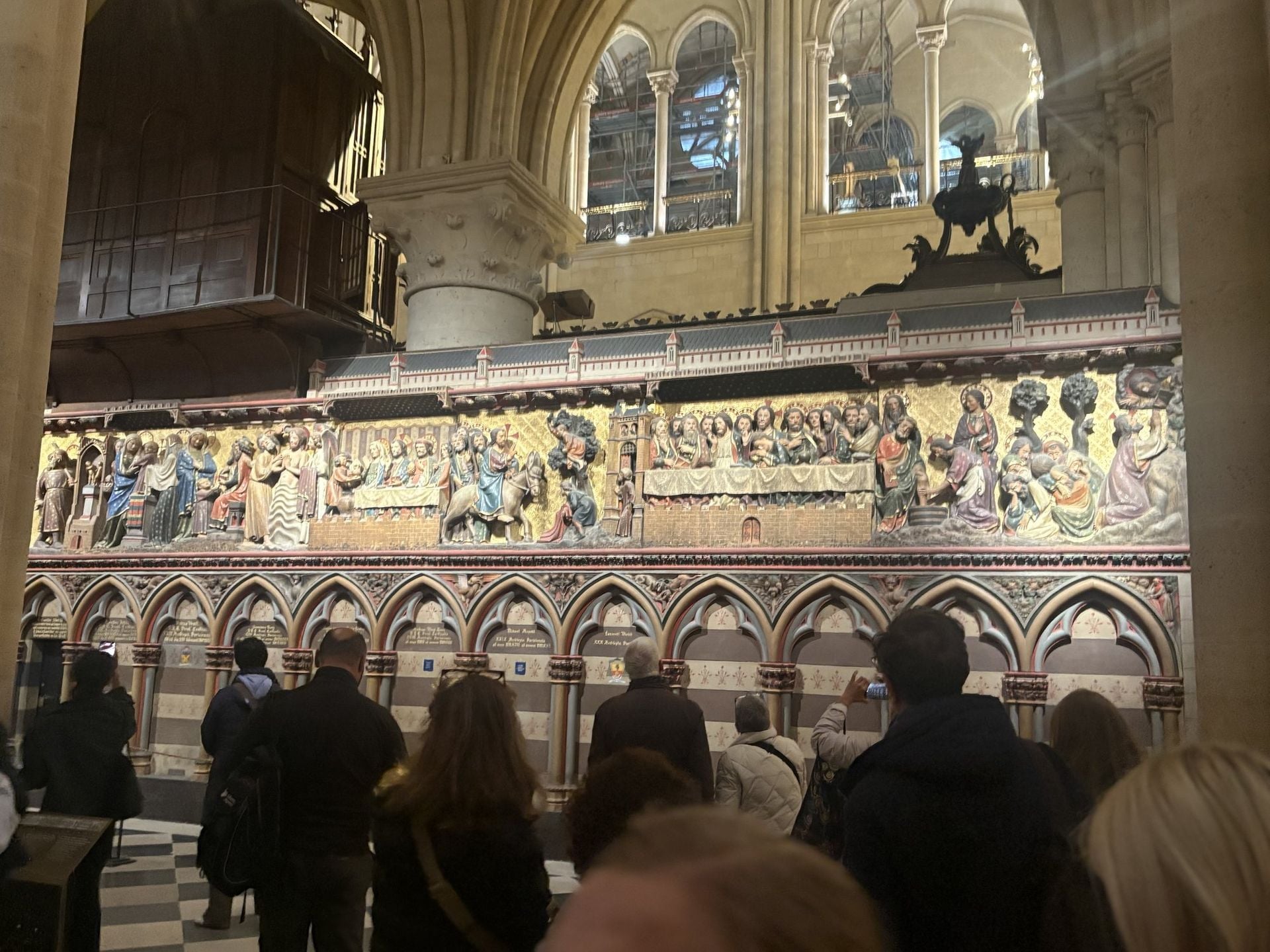
This was a surprise. Around the choir runs a wall of stone carvings, painted in bright colours on a gold background. It dates from the 14th century and tells the life of Christ, scene by scene, like a medieval comic strip. On this side we could pick out the long table of the Last Supper.
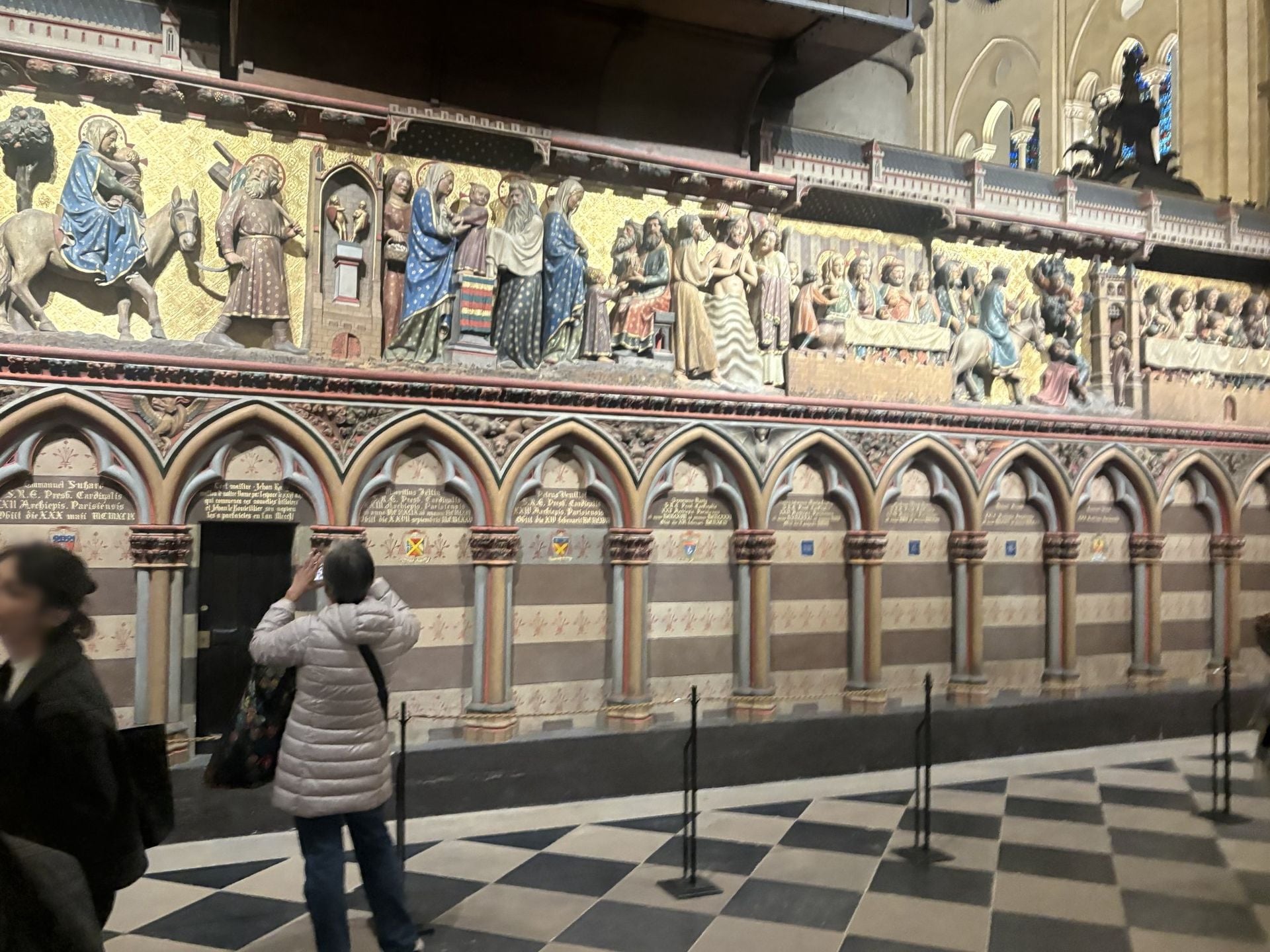
Further along: Mary and the baby on a donkey. The restorers cleaned these carvings after the fire, and the colours really pop now.
Shhh! A wall built for quiet
According to the cathedral, worshippers in the old days were fewer than today but apparently noisier. So between about 1300 and 1350 a wall went up around the choir to cut the noise for the canons praying inside, and it was decorated with scenes from the life of Christ. Pierre de Chelles started it, Jean Ravy carried on, and Ravy’s nephew Jean le Bouteiller finished it in 1351. At one point the colours were covered in whitewash, and they were brought back in the 19th-century restoration.
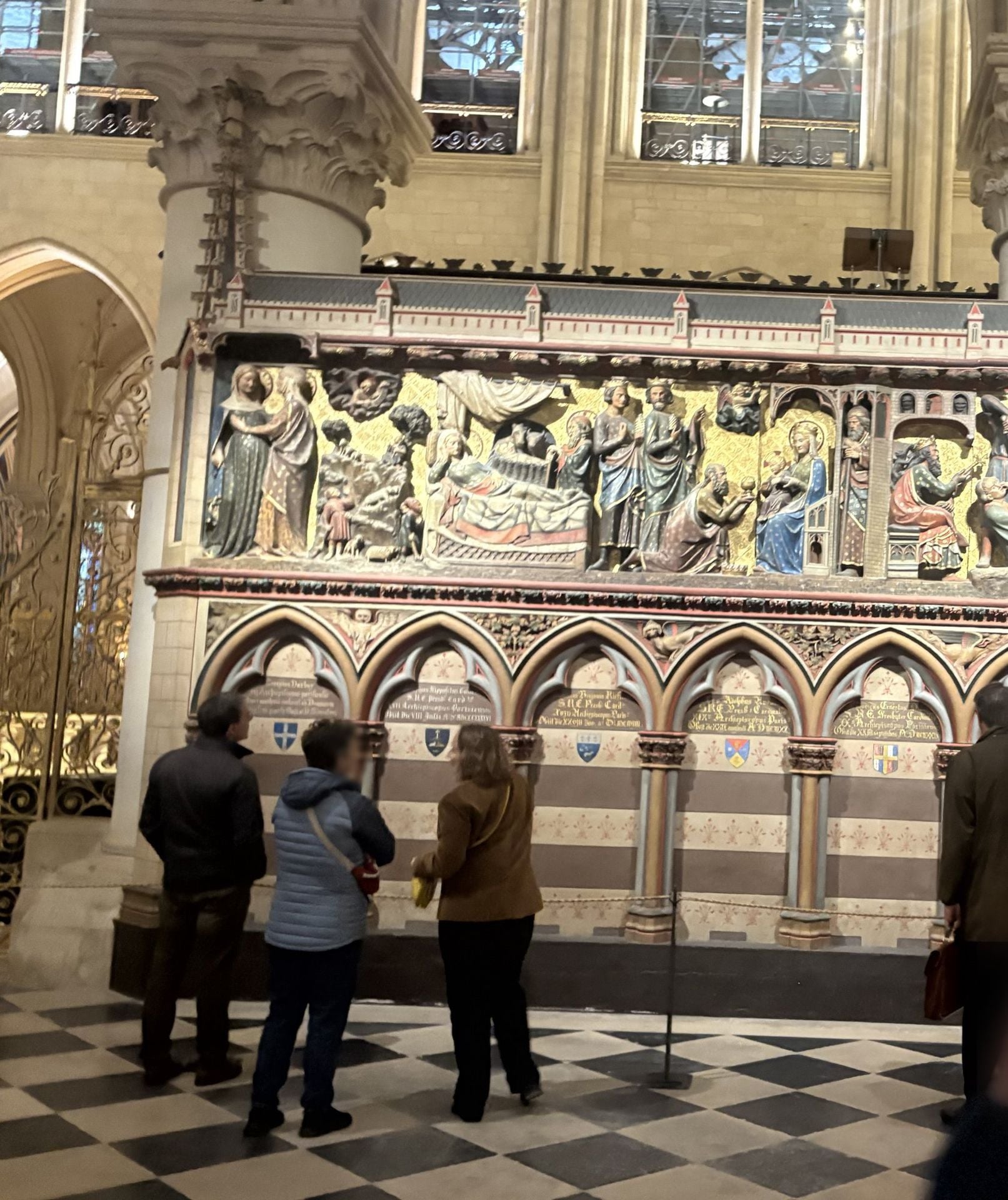
The chapels with their own stories
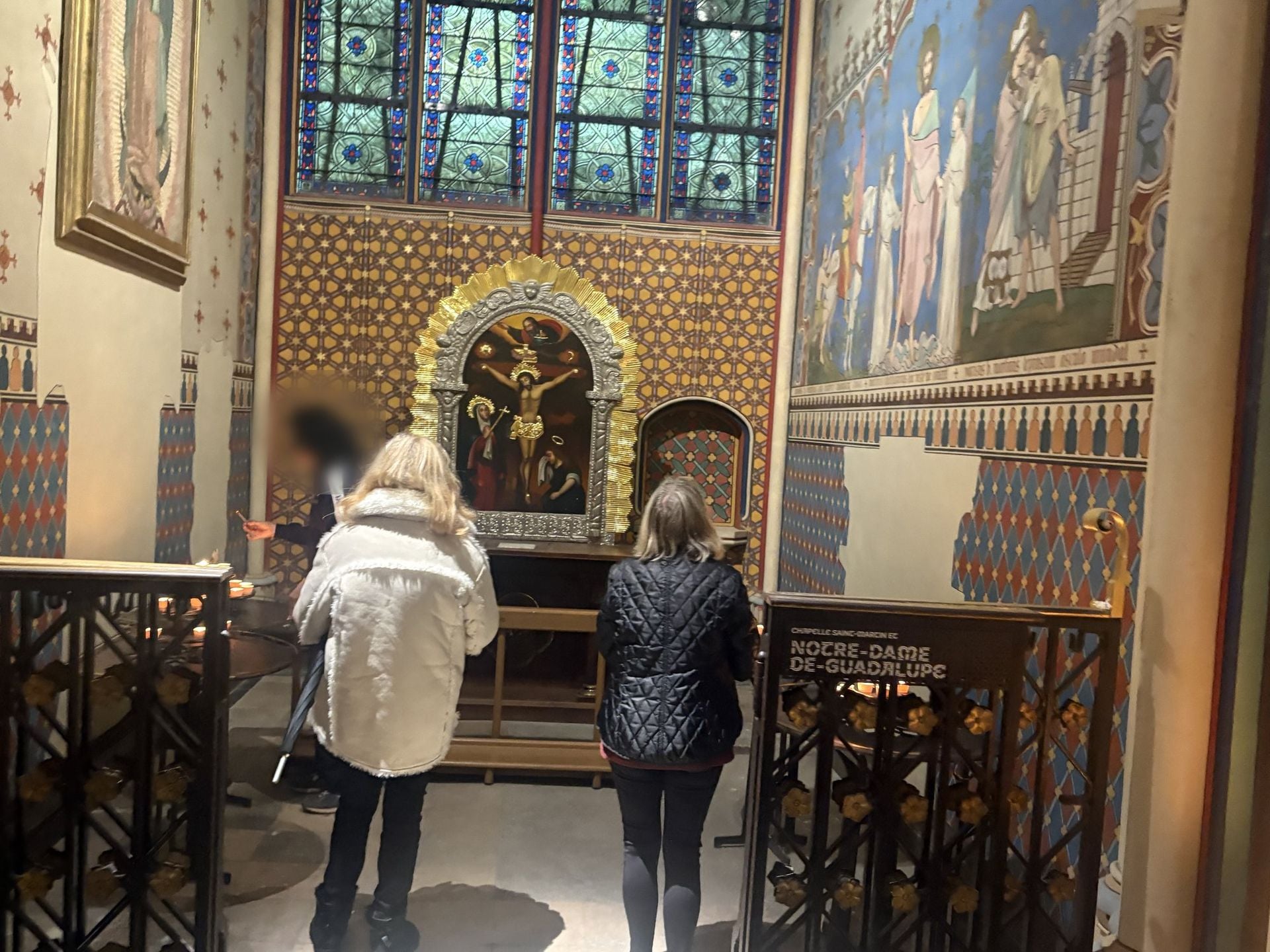
The chapel of Notre-Dame de Guadalupe, with its gold-framed painting and patterned walls. As Filipinos, we always feel a little at home when we see Our Lady of Guadalupe far from home.
Did you know? Our Lady of Guadalupe and the Philippines
The image in this chapel is a replica sent from Mexico, the same size as Saint Juan Diego’s tilma (his cloak), and it was crowned here on 26 April 1949, after the Second World War delayed its arrival. It came through the 2019 fire undamaged. And a fun link for us: in 1935 Pope Pius XI declared Our Lady of Guadalupe the “Celestial Patroness of the Philippines”.
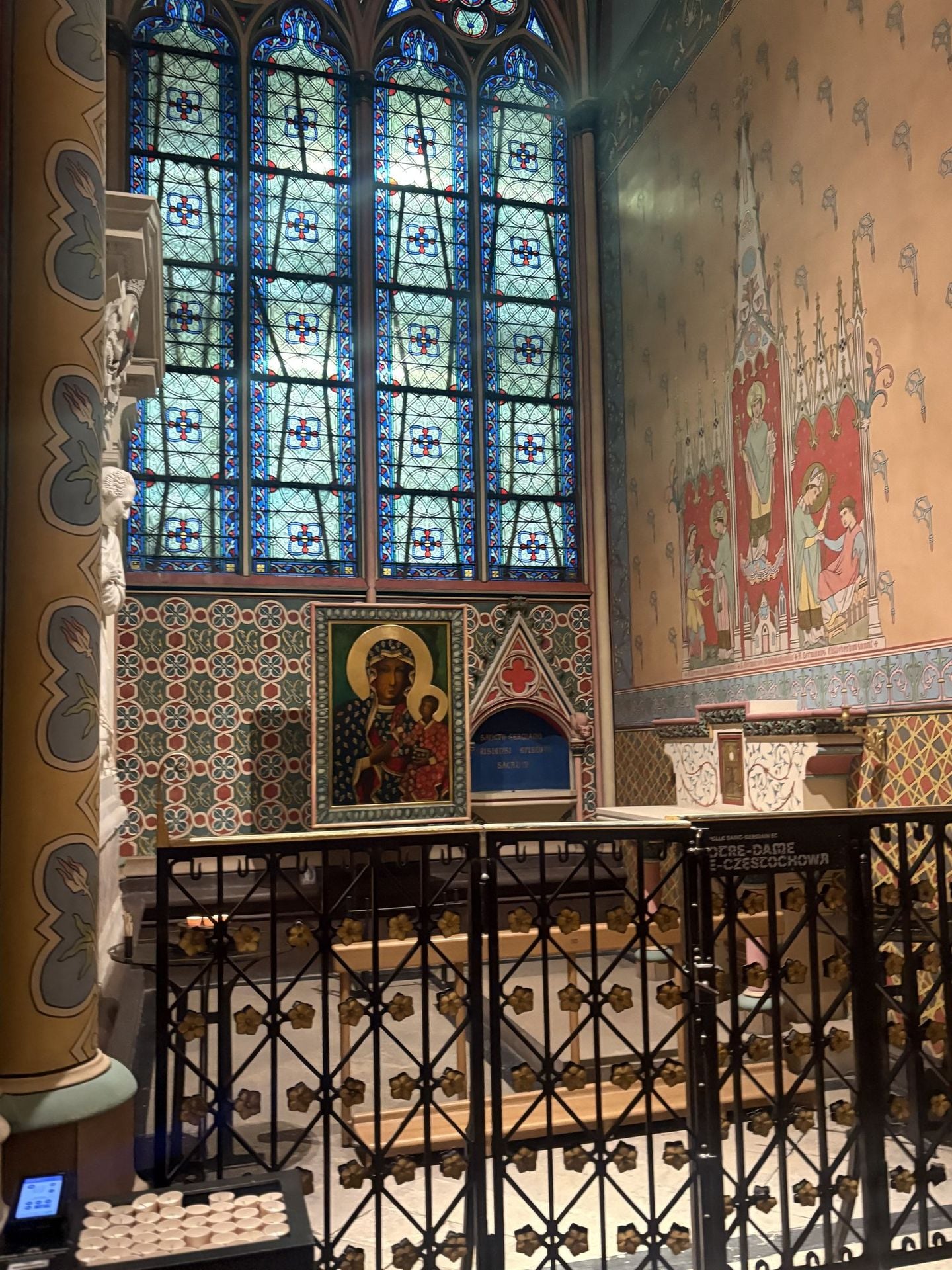
The chapel of Notre-Dame de Częstochowa, with the Black Madonna icon from Poland and painted walls all around.
Fun fact: a little piece of Poland
The icon here is a copy of the famous Black Madonna of Częstochowa, venerated in Poland since 1382. Monks from the Jasna Góra monastery gave it to Notre-Dame in 2018, and the chapel was consecrated on 1 December 2018 for the 100th anniversary of Polish independence. After restoration, the icon was put back in its chapel on 8 November 2025.
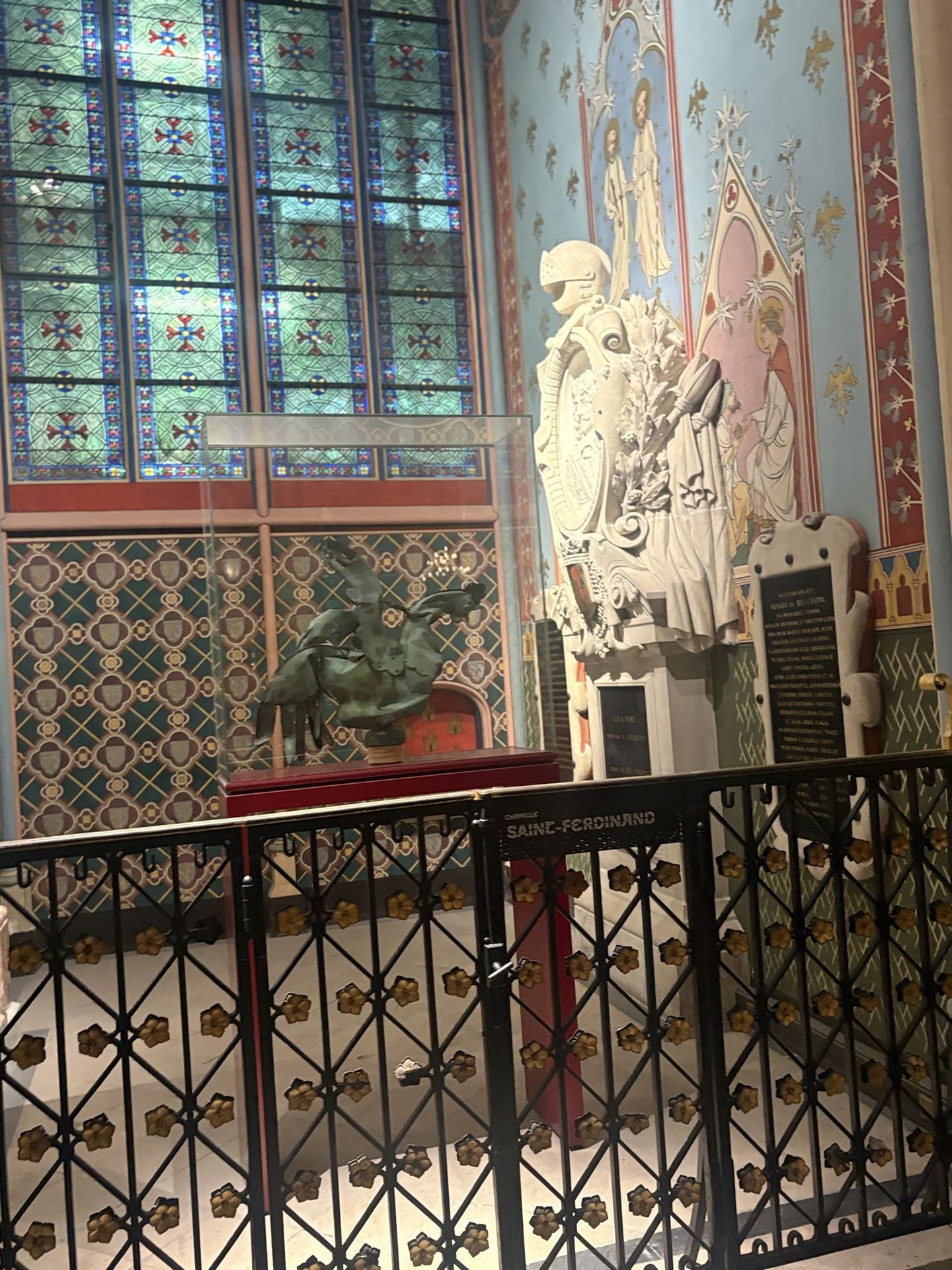
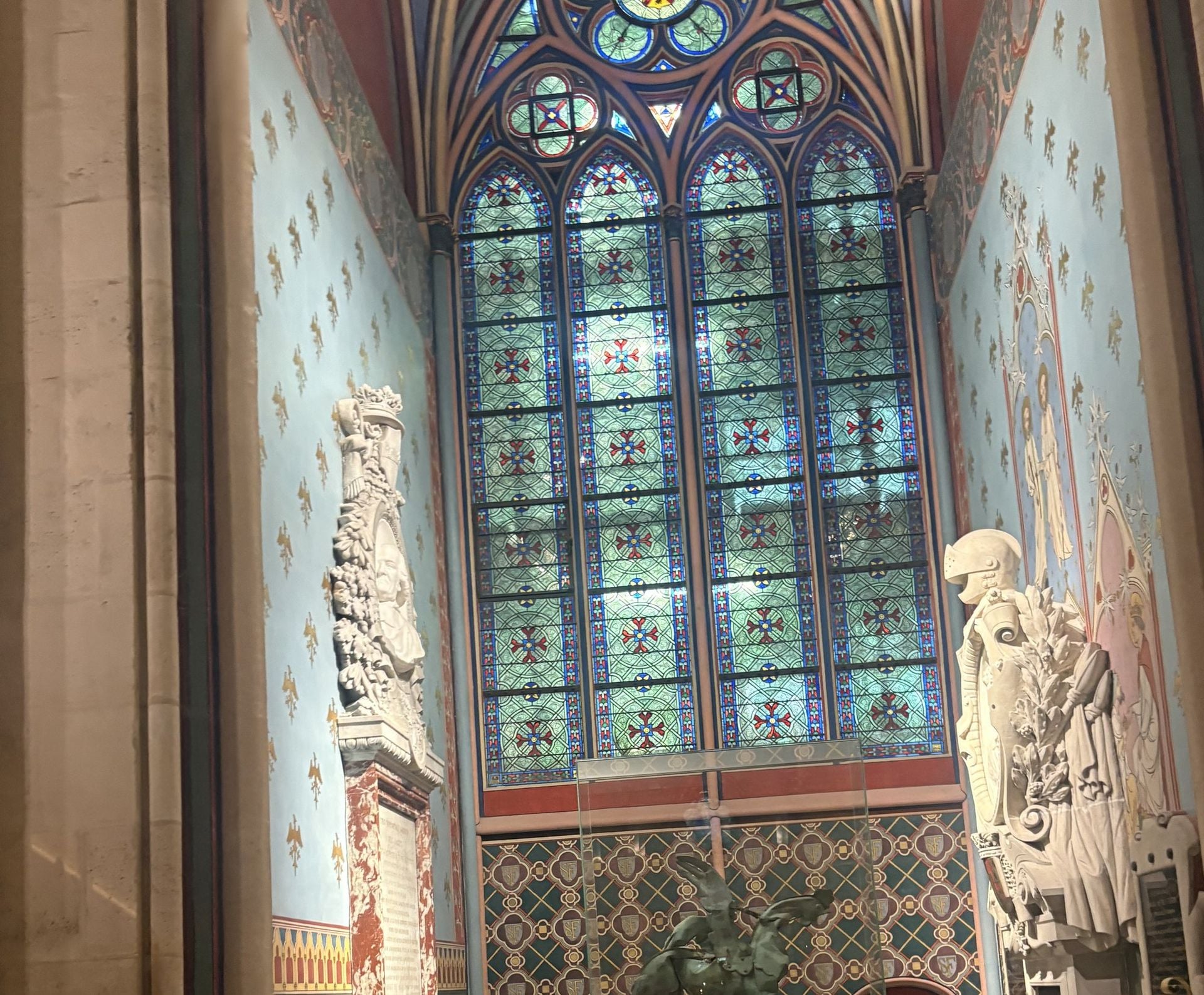
And the chapel of Saint-Ferdinand: blue walls dotted with gold, white marble monuments and tall stained glass. These painted chapels go back to the 19th-century restoration led by Viollet-le-Duc, and Saint-Ferdinand was one of the first chapels the restorers cleaned after the fire.
Viollet-le-Duc’s secret selfies
The architect behind those painted chapels and the old spire left his own face on the cathedral. Up on the spire, the copper apostle Saint Thomas, patron saint of architects, has Viollet-le-Duc’s features. He’s the only statue looking back at the spire instead of out over Paris, as if admiring his work. Lucky timing: the spire statues were taken down for restoration on 11 April 2019, just four days before the fire.
Around the ambulatory
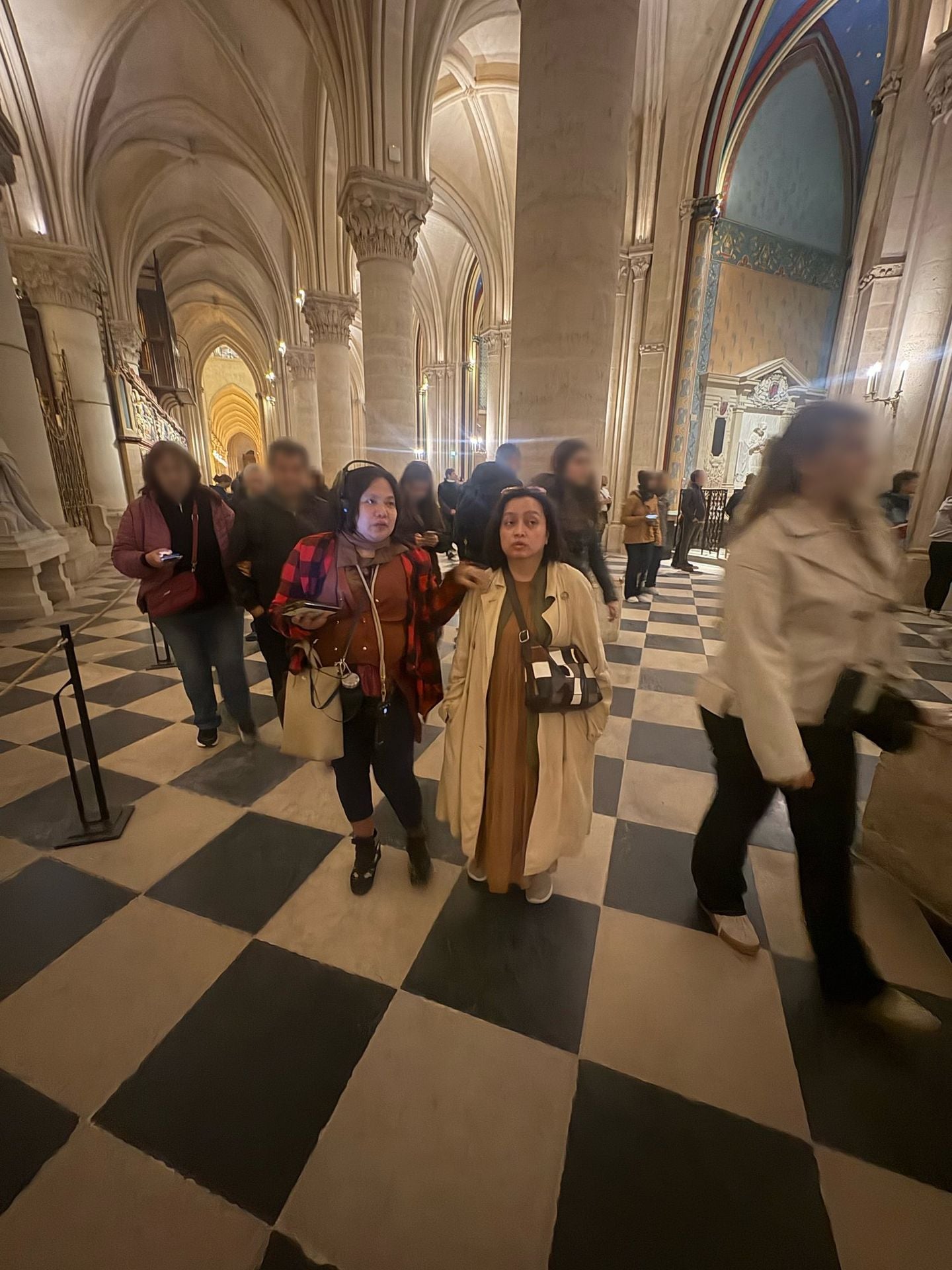
Behind the choir, the walkway loops past chapel after chapel on a black-and-white checkered floor. Dimple and Tin took it slowly, arm in arm, stopping every few steps.
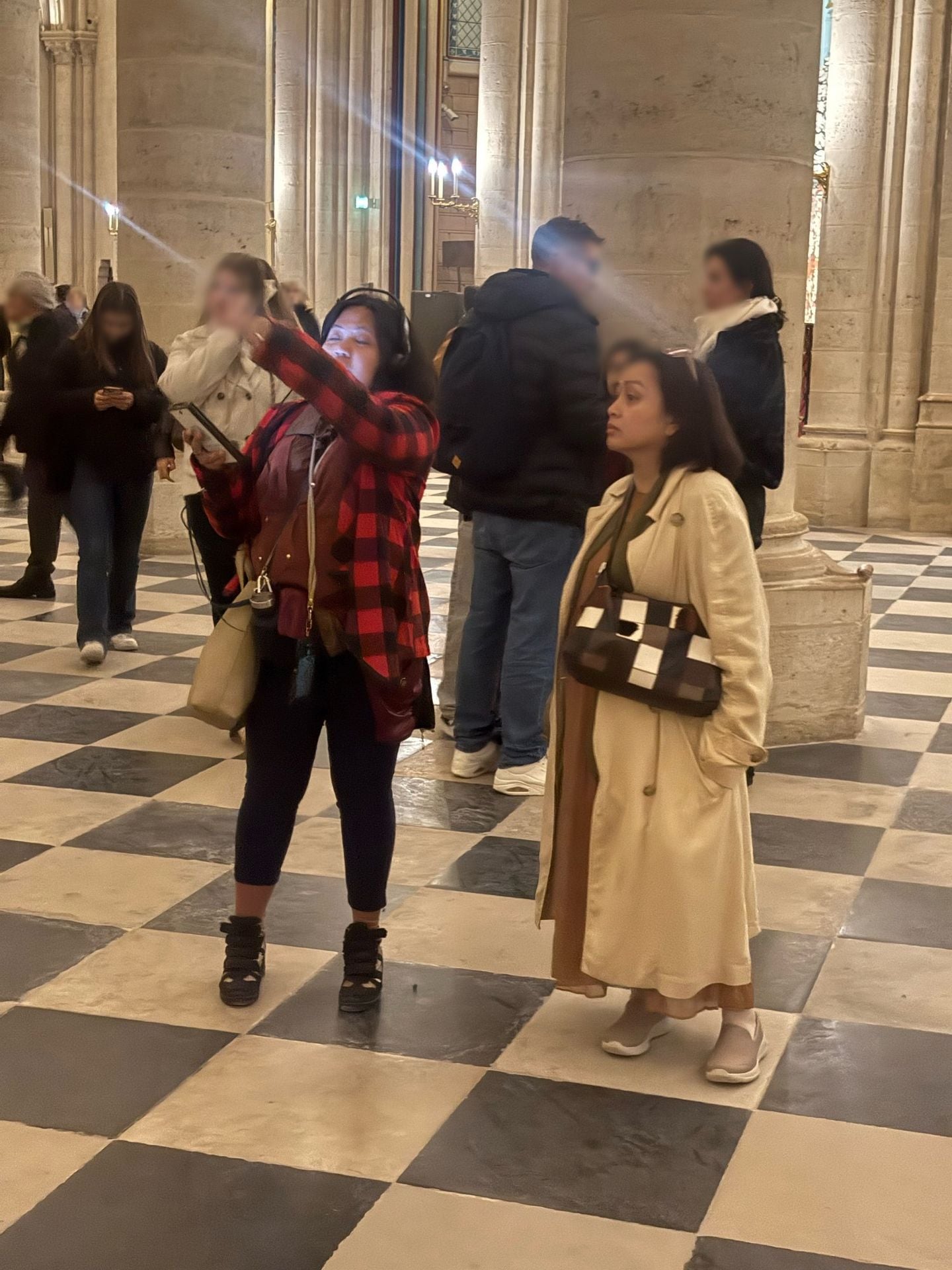
Dimple on photo duty, as always, with Tin keeping her company.
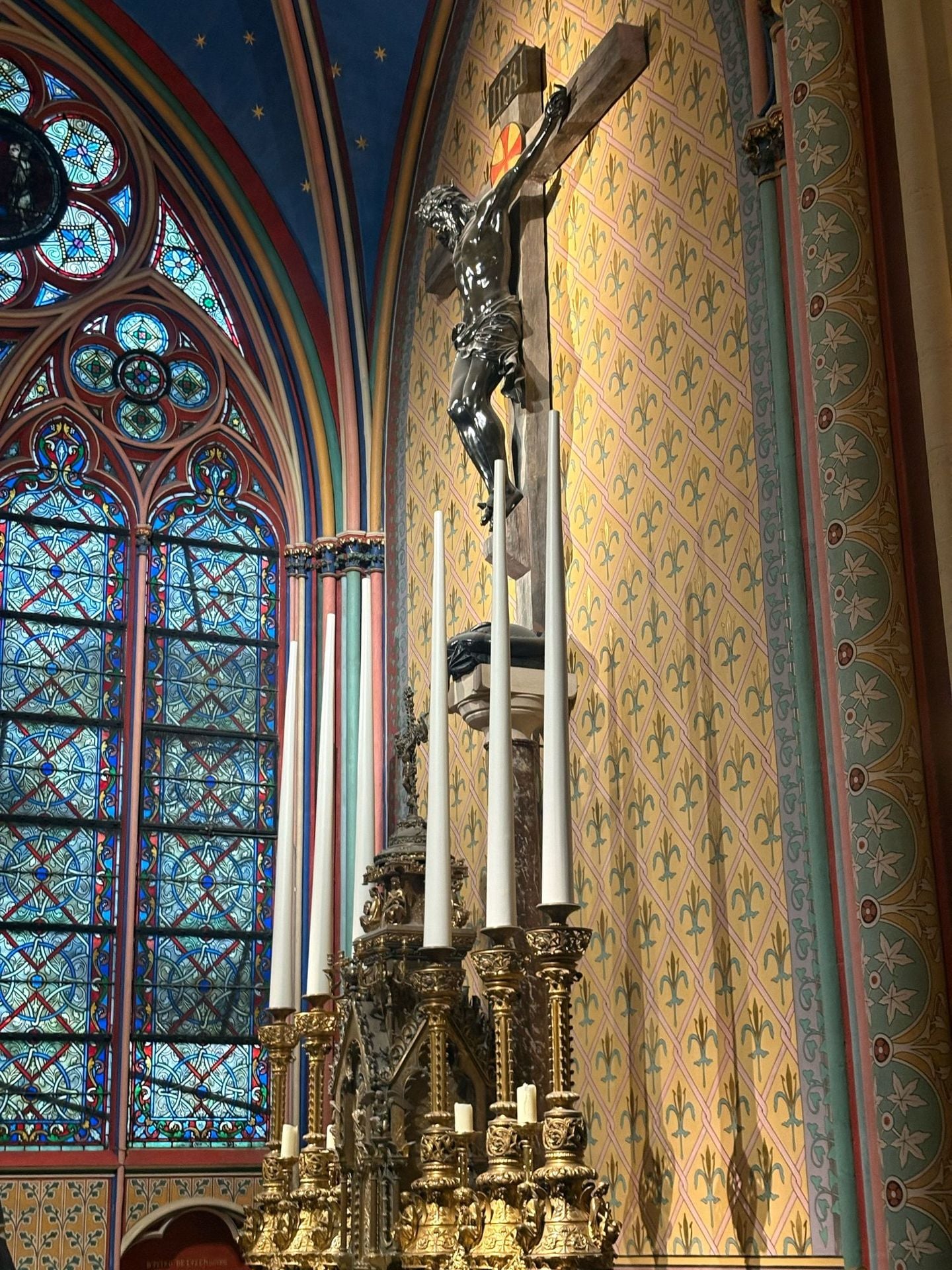
A crucifix and tall golden candlesticks against blue and red stained glass. Quiet corners like this are everywhere along the ambulatory.
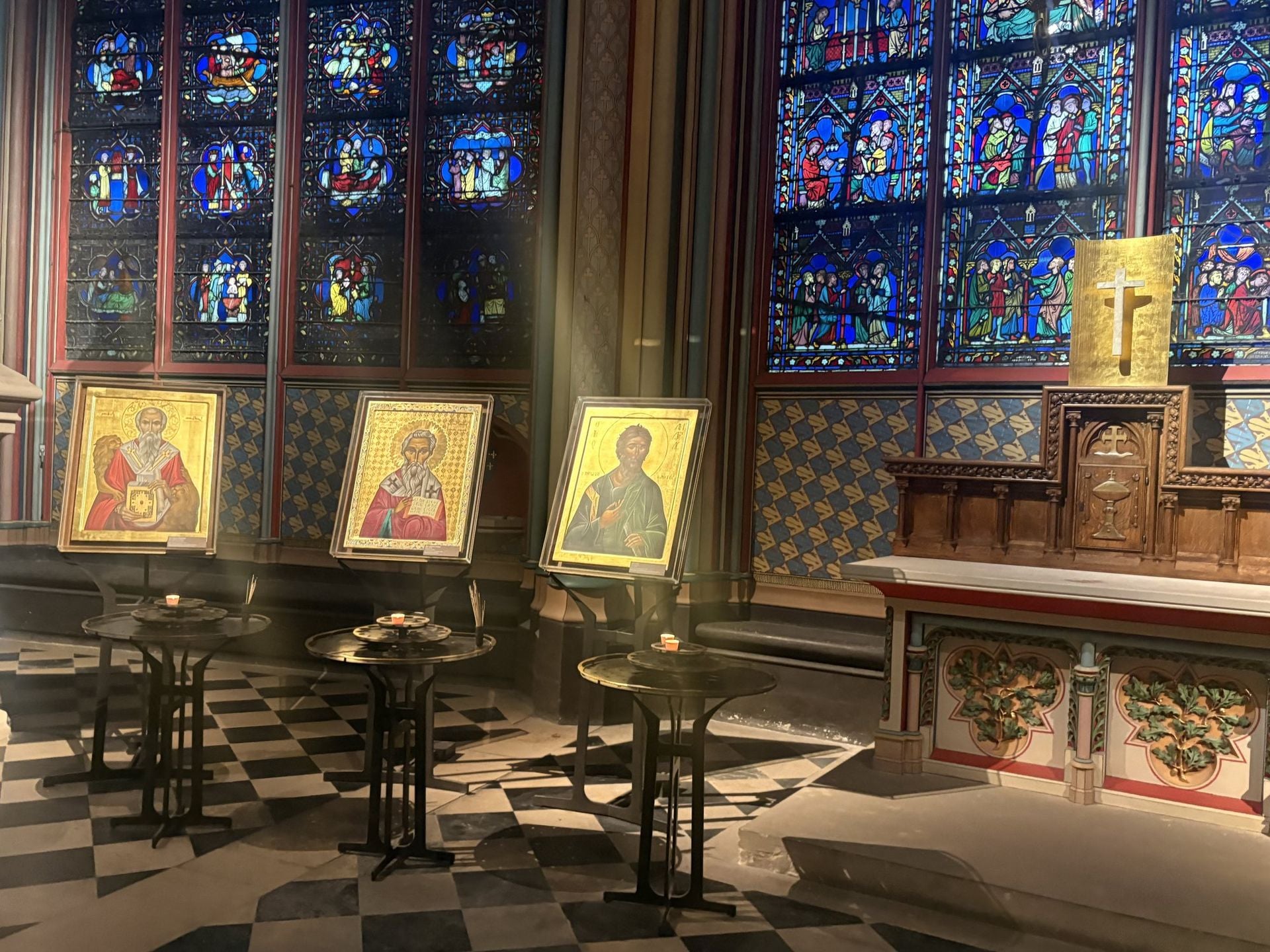
In one chapel, painted icons stand on easels with little candle tables in front of them, all lit by the stained glass behind.
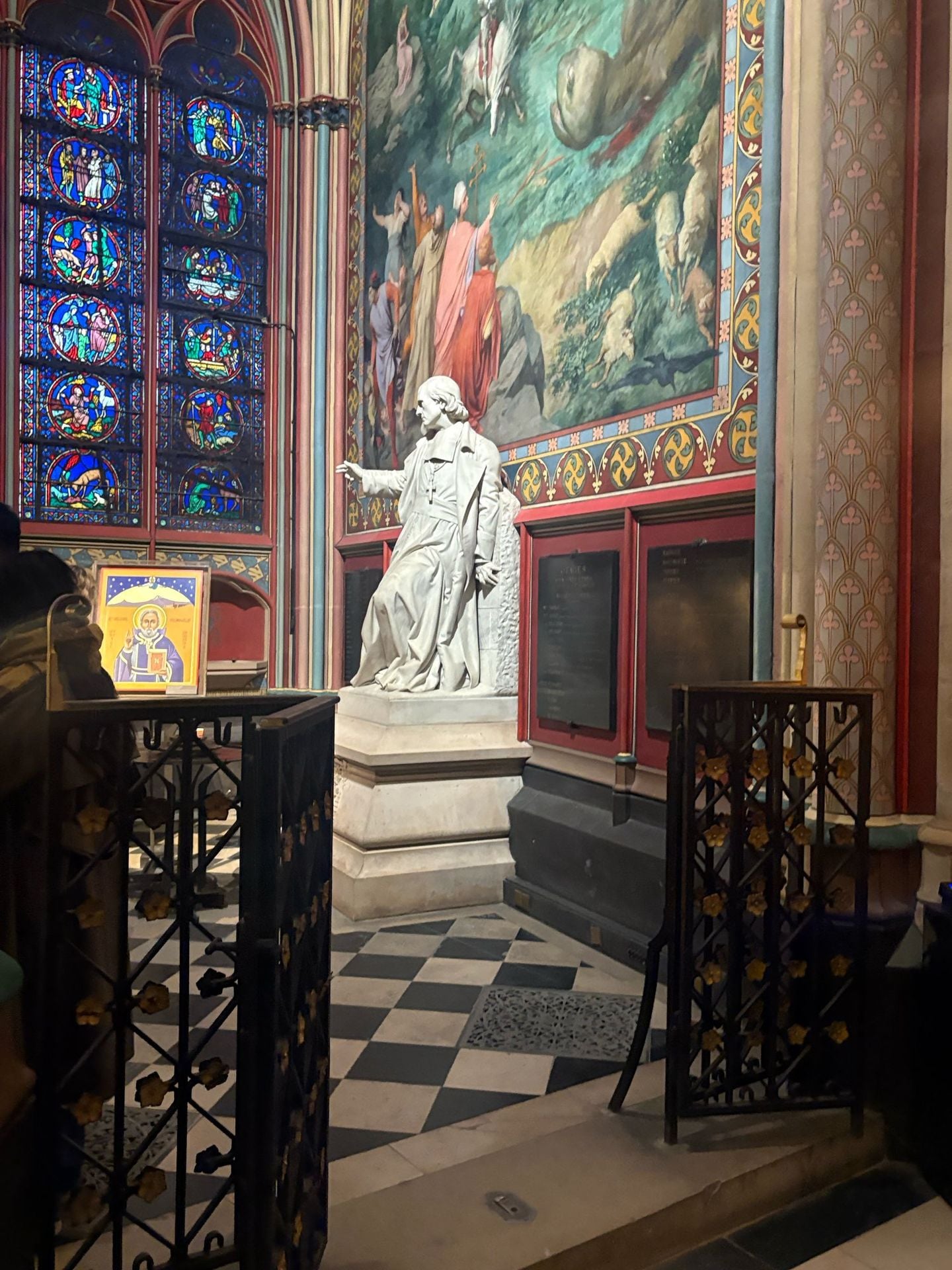
A white marble cleric kneels below a big painted mural, one arm reaching out.
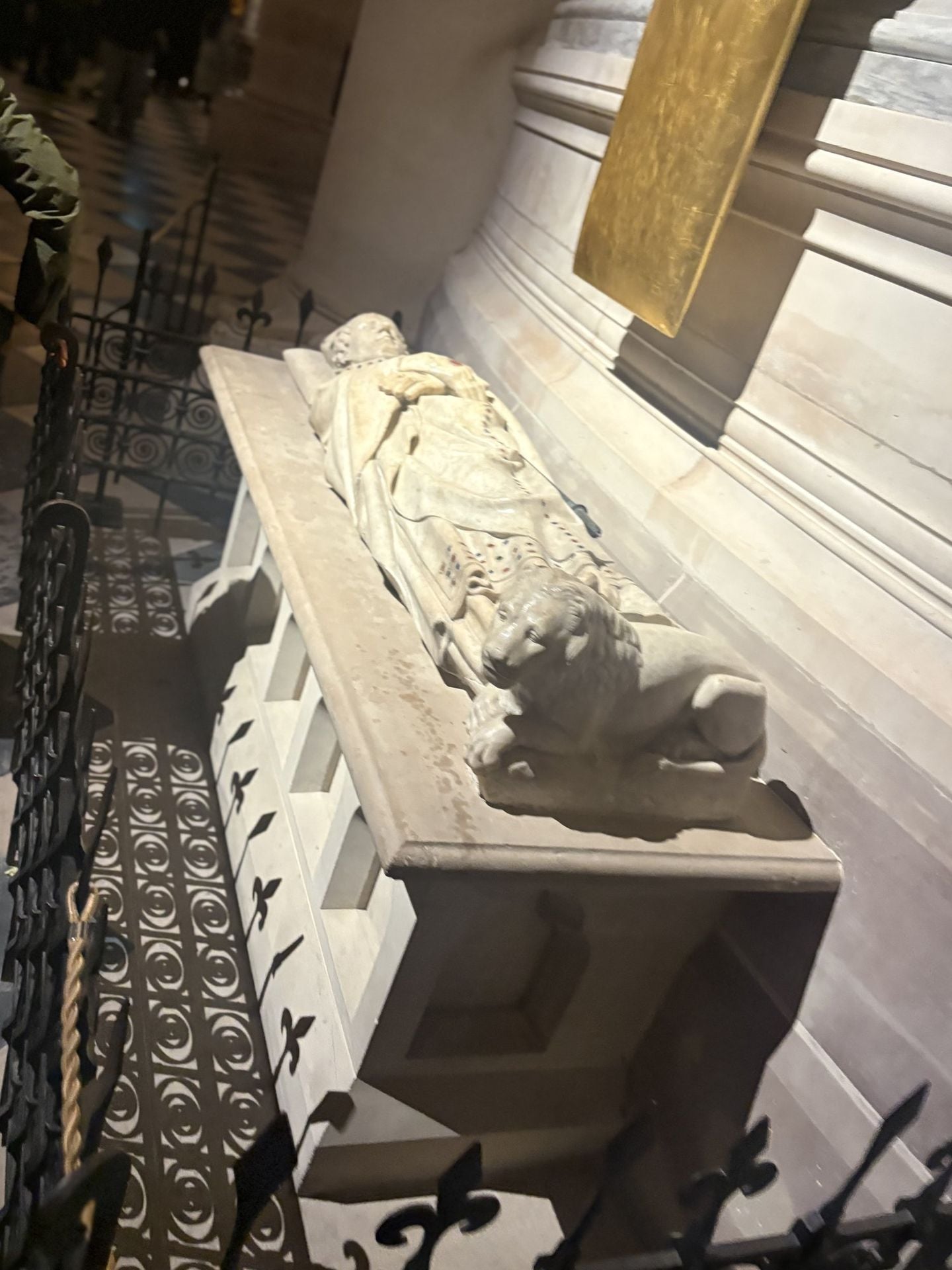
And a stone figure lying on a tomb, hands joined, with a lion resting at its feet.
The Harcourt monument in the Saint-Guillaume chapel
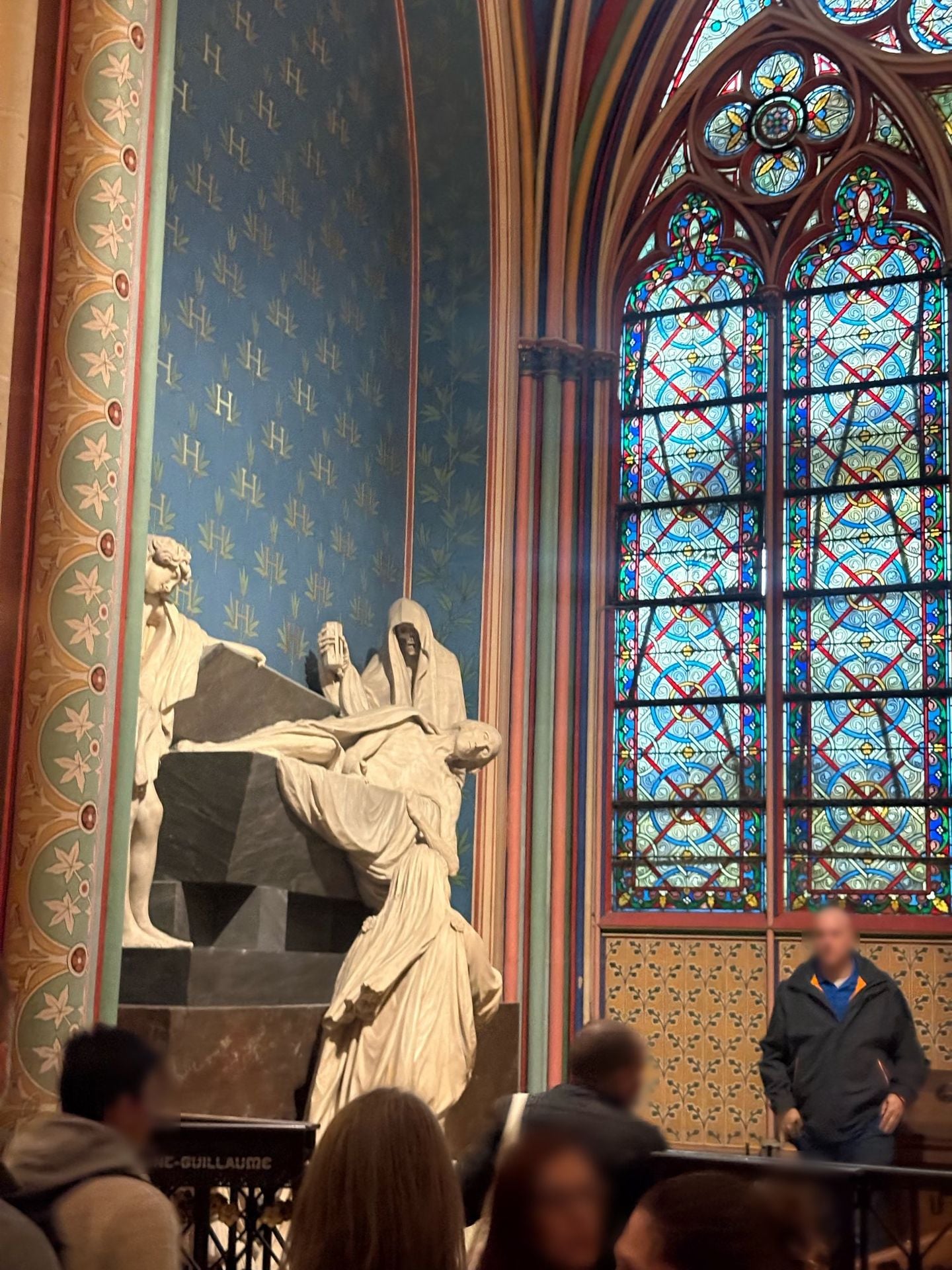
This one stopped us. In the Saint-Guillaume chapel stands the marble mausoleum of the Count of Harcourt, carved by Jean-Baptiste Pigalle in 1776 for the count’s widow. The count rises from his tomb towards his weeping wife, while a hooded figure of Death holds up an hourglass. It’s dramatic, a little spooky, and very beautiful.
A love story in marble
The countess’s contract with Pigalle, signed in 1771, spelled out the whole scene: a guardian angel lifting the tomb lid, the count reaching out to his wife, and Death holding an hourglass to show her that her time has come. In 1774, at Pigalle’s request, the chapel’s colourful stained-glass window was replaced with clear glass, so real daylight would fall on the mausoleum.
The chapel of Notre-Dame-des-Sept-Douleurs
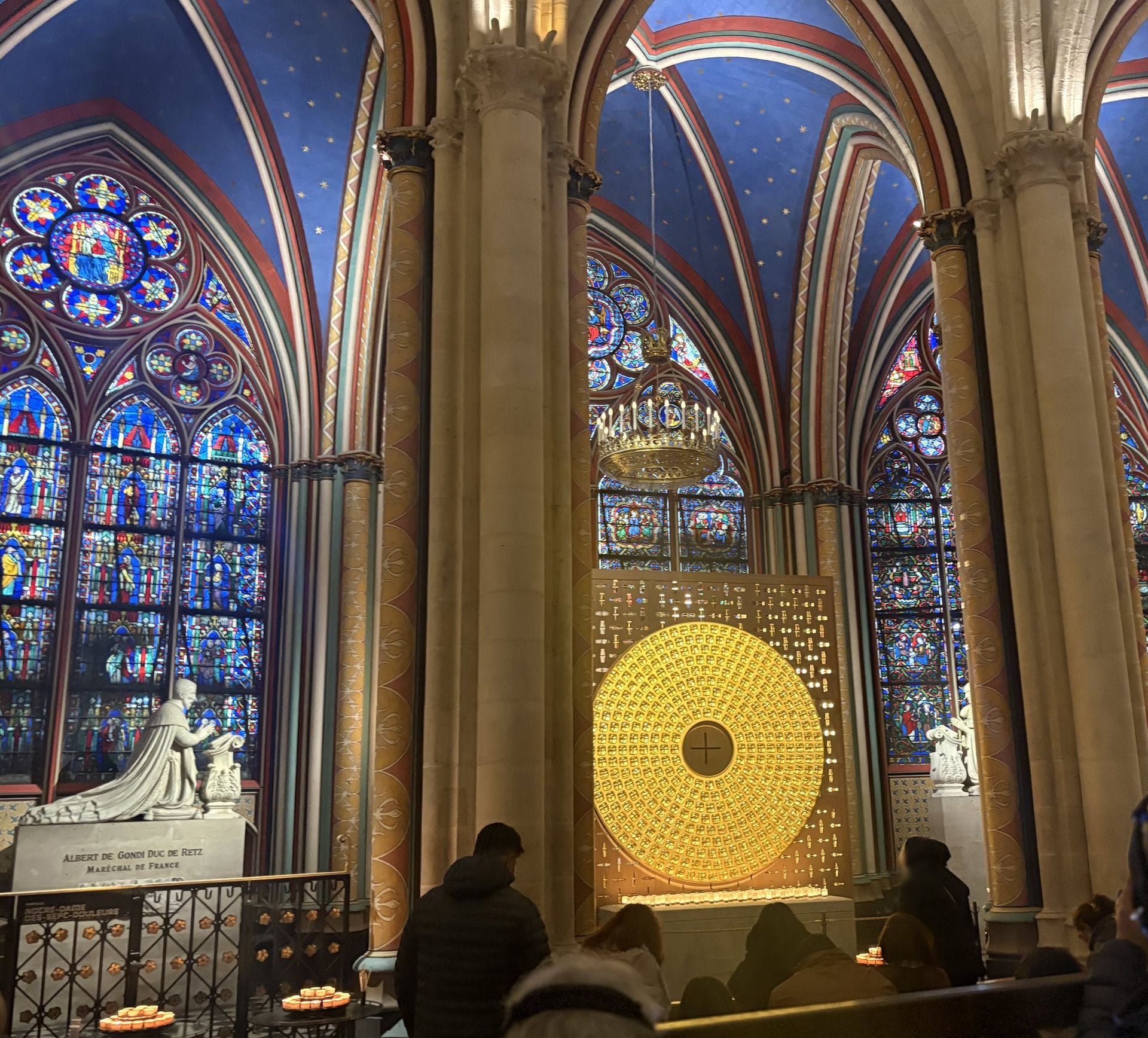
Right behind the choir is the chapel of Notre-Dame-des-Sept-Douleurs, and it glows. The big golden circle is the new reliquary made by designer Sylvain Dubuisson for the Crown of Thorns, the cathedral’s most treasured relic, which was saved from the 2019 fire. On the left, a white marble figure kneels on the monument of Albert de Gondi, Duc de Retz, Maréchal de France.
Did you know? The Crown of Thorns’ big adventures
King Louis IX (Saint Louis) acquired the Crown of Thorns in 1238, and it arrived in Paris on 19 August 1239. He had the Sainte-Chapelle built nearby just to keep it. During the 2019 fire, the crown was locked in a secure safe: rescuers had to break the reliquary around it and find the code to open the safe. Today it sits in Dubuisson’s golden cedar-wood reliquary, and the cathedral displays it for veneration on Fridays (check the official site for times).
The Treasury
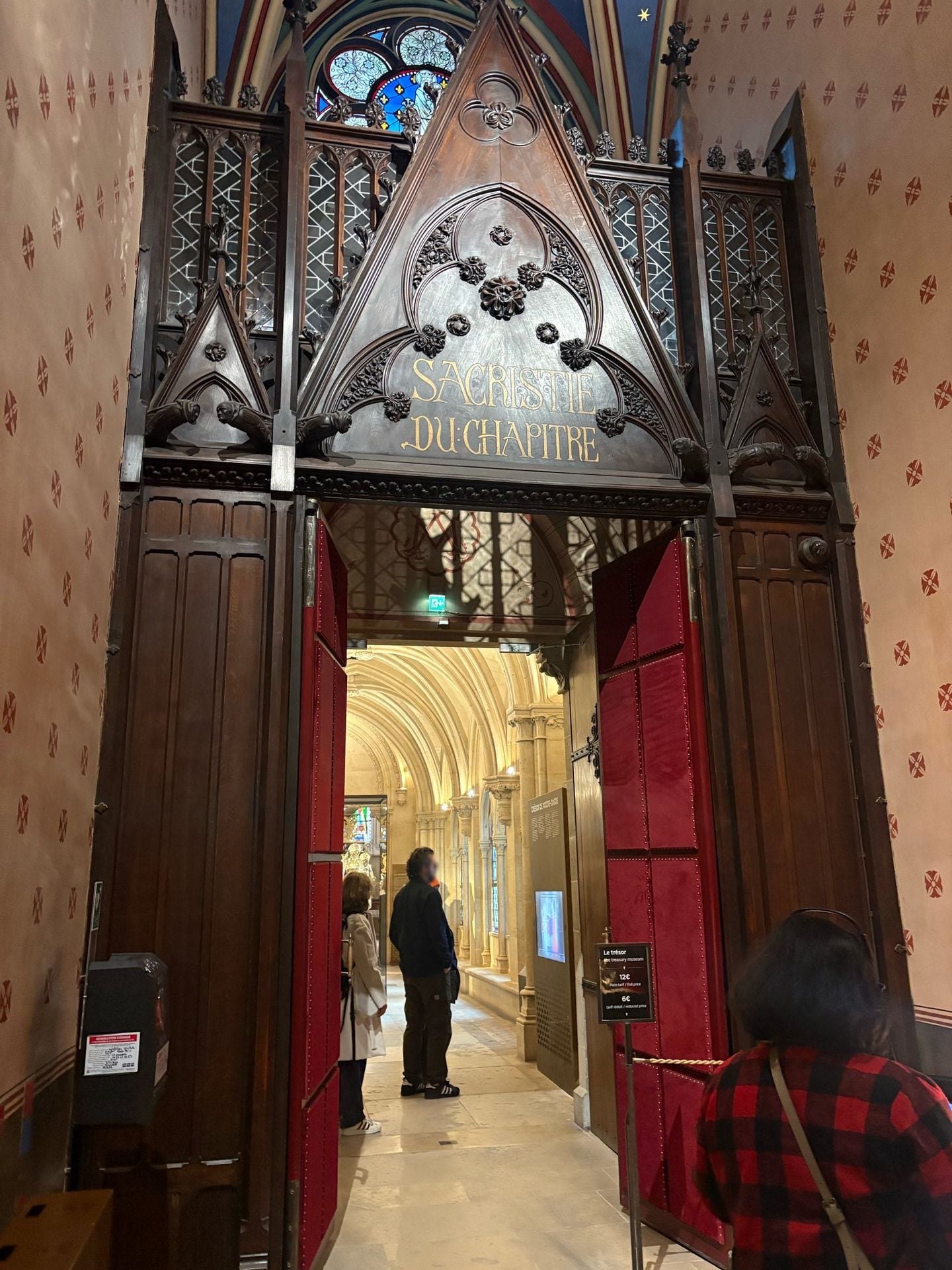
Along the south side of the ambulatory, a carved wooden doorway marked “Sacristie du Chapitre” leads to the Treasury, where the cathedral keeps its precious liturgical objects. Unlike the cathedral itself, the Treasury is paid: the sign at the door showed €12 full price and €6 reduced. Dimple went in to see it.
Plot twist: the treasure that vanished
The cathedral’s old treasure was destroyed during the French Revolution, and not a single object from it survives. The collection was rebuilt from 1804, when the relics of the Passion came over from the Sainte-Chapelle. The Treasury’s neo-Gothic home was built between 1845 and 1850 by Lassus and Viollet-le-Duc, who also designed its big cupboards.
Quick tips for visiting Notre-Dame
- Entry is free. You can book a free time slot on the official Notre-Dame website to skip some of the queue, but it’s optional.
- Don’t pay for “tickets”. The cathedral says entry is completely free and no third party is allowed to sell tickets. If someone wants money to get you in, walk away.
- Opening hours (as of Nov 2026): Monday to Friday 7:50am to 7pm, Thursday until 10pm, weekends 8:15am to 7:30pm. Last entry is 30 minutes before closing. Check the official site before you go, as times change for services and events.
- The Treasury is extra. It’s inside, off the south ambulatory, and you buy tickets at its own desk. The sign during our visit showed €12 full price and €6 reduced; check the official site for current prices and hours.
- It’s a working church. Masses happen through the day, so keep your voice down and your phone on silent.
- Look up, then look sideways. Everyone looks up at the vaults and the rose window. Don’t skip the chapels, the painted choir wall and the walk around the ambulatory.
- Dress warm in autumn. The square out front is breezy, and there can be a queue outside.
Getting there
- Metro: Line 4 to Cité, a short walk from the square.
- RER: B or C to Saint-Michel–Notre-Dame, just across the river.
New to the metro? Our Paris metro guide for first-timers covers tickets, tapping your phone and changing lines without getting lost.
FAQ
Is Notre-Dame de Paris open again?
Yes. It reopened to visitors on 8 December 2024 after the 2019 fire.
Is it free to go inside Notre-Dame?
Yes, entry to the cathedral is free. Booking a time slot on the official website is optional.
Did the rose windows survive the fire?
Yes. The great medieval rose windows came through the 2019 fire with little or no damage.
What is a rose window?
A large round Gothic window decorated with stone tracery and filled with stained glass. Notre-Dame has three: west, north and south.
What is the painted wall around the choir?
It’s the choir screen: 14th-century stone carvings showing the life of Christ, painted and gilded, and cleaned during the restoration.
Where is the Crown of Thorns in Notre-Dame?
In the chapel of Notre-Dame-des-Sept-Douleurs, behind the choir, in a golden reliquary designed by Sylvain Dubuisson.
Is the Notre-Dame Treasury free?
No. The cathedral is free, but the Treasury is paid. During our visit the sign showed €12 full price and €6 reduced.
What’s the nearest metro to Notre-Dame?
Cité on Line 4. RER B and C stop at Saint-Michel–Notre-Dame.
Keep reading: our Seine cruise past Notre-Dame · our Louvre day · Paris metro guide · Sapporo ramen in Paris
Trip recap: our whole Europe trip, from Zurich to Paris