






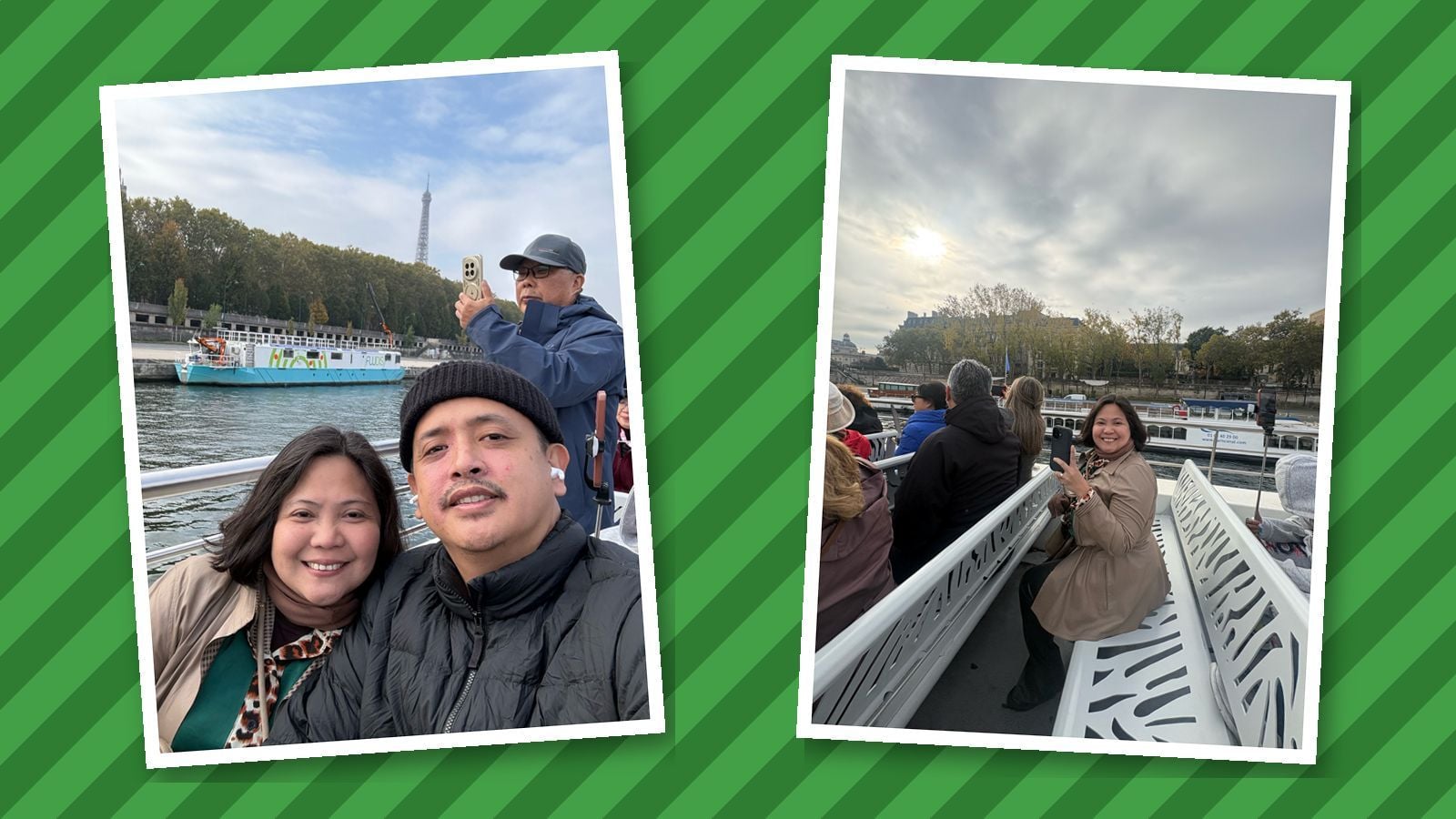
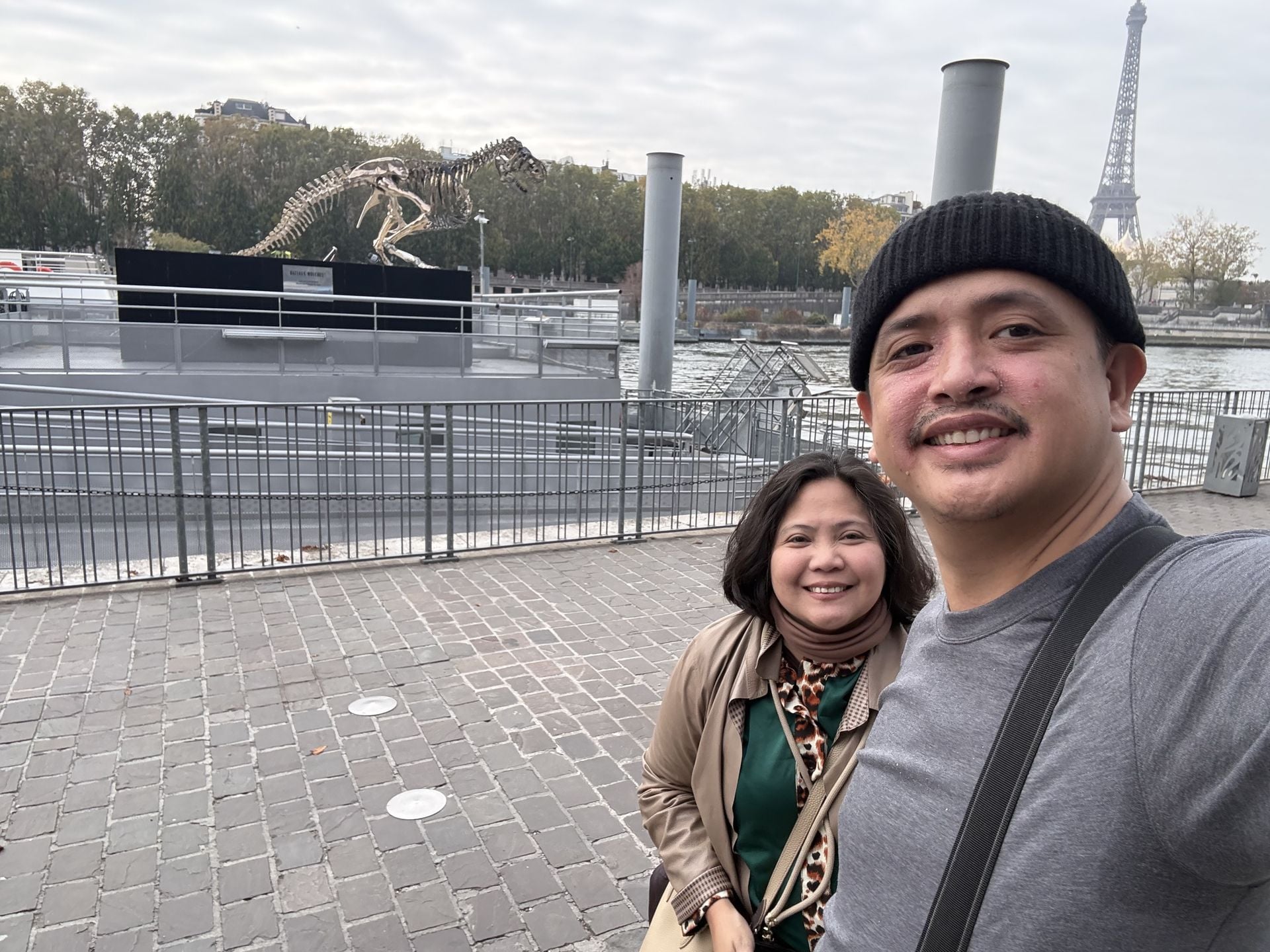
The Eiffel Tower was behind us. So was a giant dinosaur skeleton, standing on a barge by the river like it had also bought a ticket.
Not something you expect on the Seine. Dimple and I took the selfie anyway, because when Paris gives you a T-rex and a tower in one frame, you don’t argue.
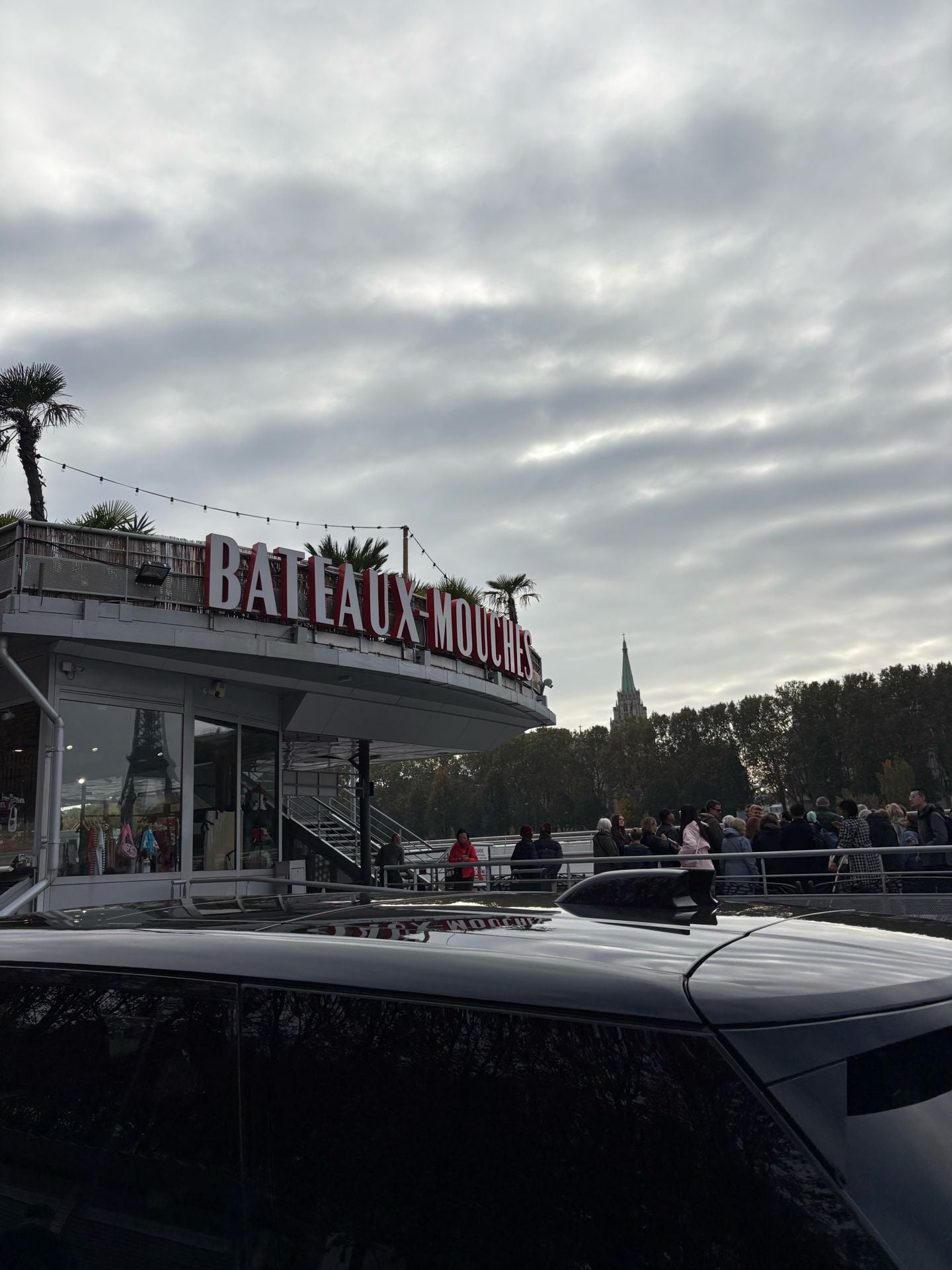
Grey Sky, Big Sign
The sky was overcast, the full Paris-in-autumn grey. Nobody told the Bateaux-Mouches sign, which stayed loud and red above the pier as if the sun were out.
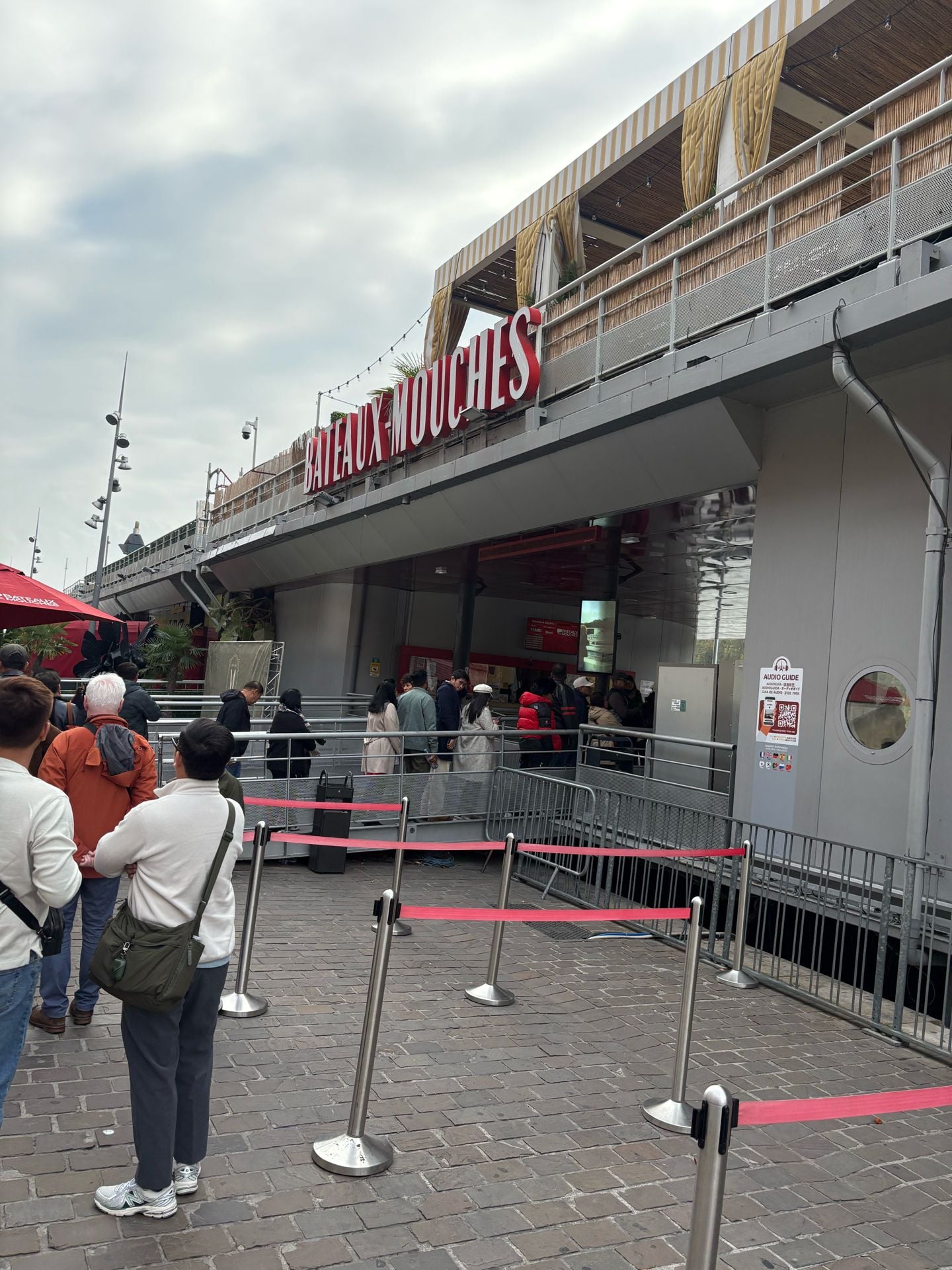
The Queue (Part of the Experience)
There was a queue. There is always a queue. It moved through the ropes and the turnstiles to the boat area, and then that was it: the one Paris attraction where the city moves past you.
Top Deck, Grey Sky, No Regrets
We went straight for the open top deck. Overcast autumn day, rows of white benches, the whole of Paris in front of us. The sky stayed grey the whole way. The views didn’t care.
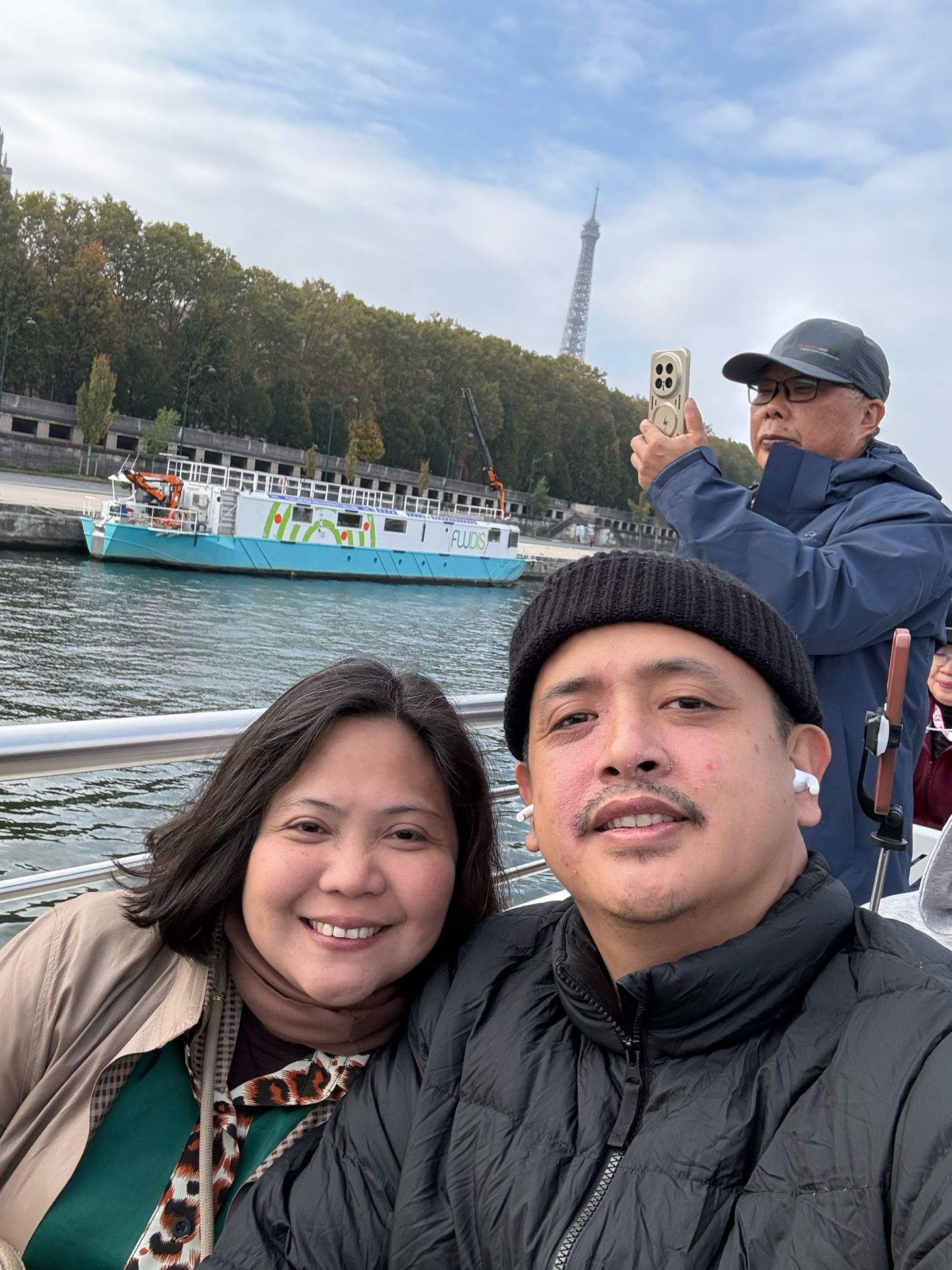
Dimple claimed a bench and her phone camera didn’t rest for the rest of the cruise.
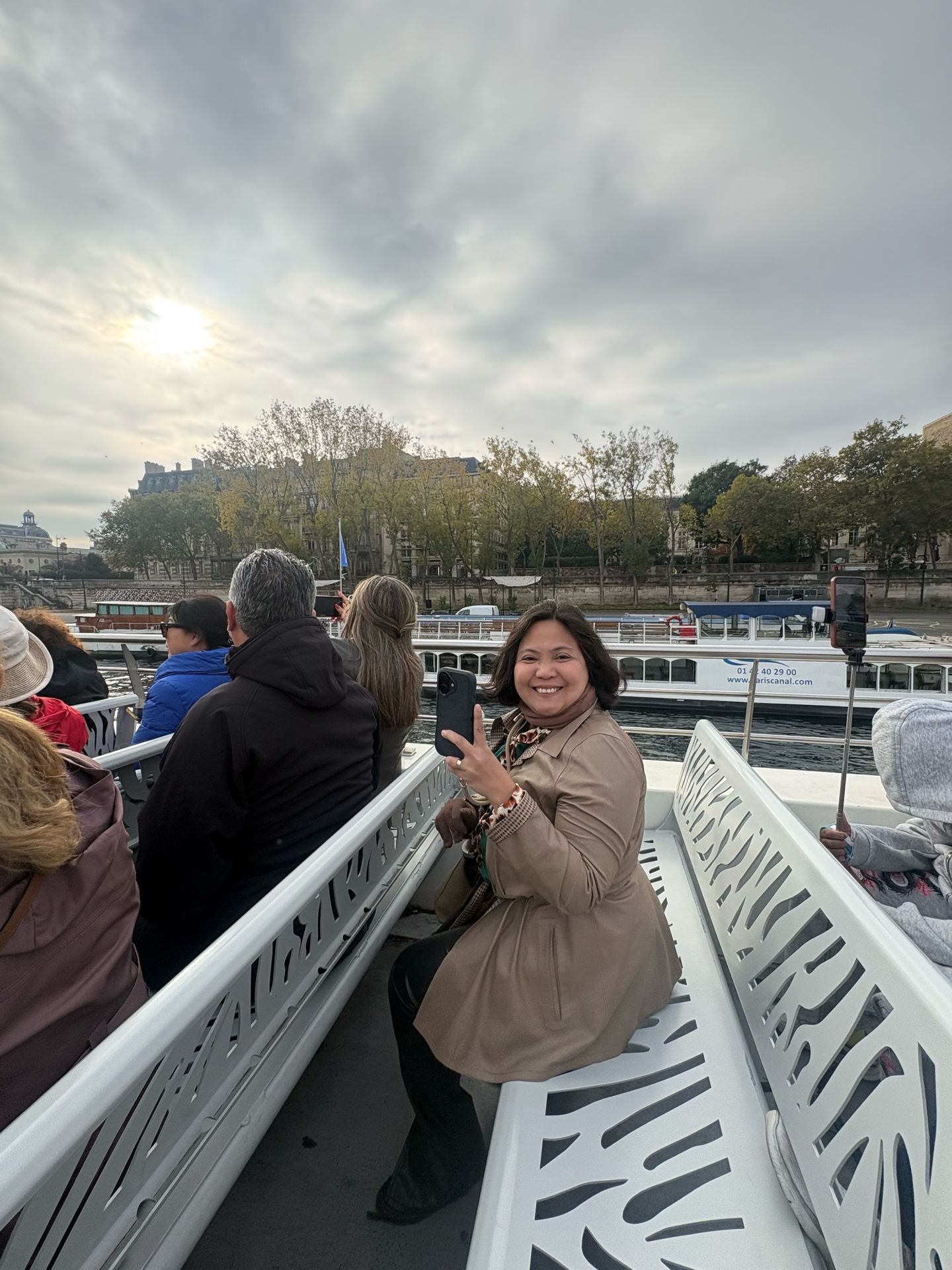
Up the River
Bateaux-Mouches heads upriver first, and the history starts stacking up fast.
The Louvre. Before it was the world’s most famous museum, it was a fortress. The base of Philippe Auguste’s medieval castle, moat and all, is still down there under the Cour Carrée.
The Hôtel de Ville (Town Hall). It was burned in 1871 and rebuilt in its old Renaissance style, but with electricity, telephones and lifts. It’s also where de Gaulle gave his “Paris libéré !” speech in 1944. Fun twist: for all that grandeur, Paris didn’t get an elected mayor until 1977.
The Conciergerie. It started as part of a medieval royal palace and later became a prison. Its most famous prisoner was Marie-Antoinette, who spent 76 days here in 1793, watched night and day by two guards. There’s now a memorial chapel where her cell was.
The Arab World Institute. This is where the boat turns. The building’s south side is covered in 240 metal panels that open and close with the light, like camera lenses. They worked, then jammed, then were restored in 2017. The building has blinked more reliably than some of us on a grey morning.
Notre-Dame, Up Close
Coming back, the boat slips down the small arm of the Seine between the Île de la Cité and the Left Bank. That’s where Notre-Dame shows up, right over the wall, close enough that you tilt your head back.
And there it was: the spire. After the 2019 fire it was rebuilt identically in oak and lead, and it stands 96 metres tall again. The old rooster was found dented in the rubble the day after the fire. Its replacement, designed by Philippe Villeneuve, is a flame-winged “phoenix”, installed in December 2023, and it carries relics and the names of the people who worked on the rebuild. They were given a five-year deadline, and the cathedral reopened in December 2024, right on time. Not many building projects can say that.
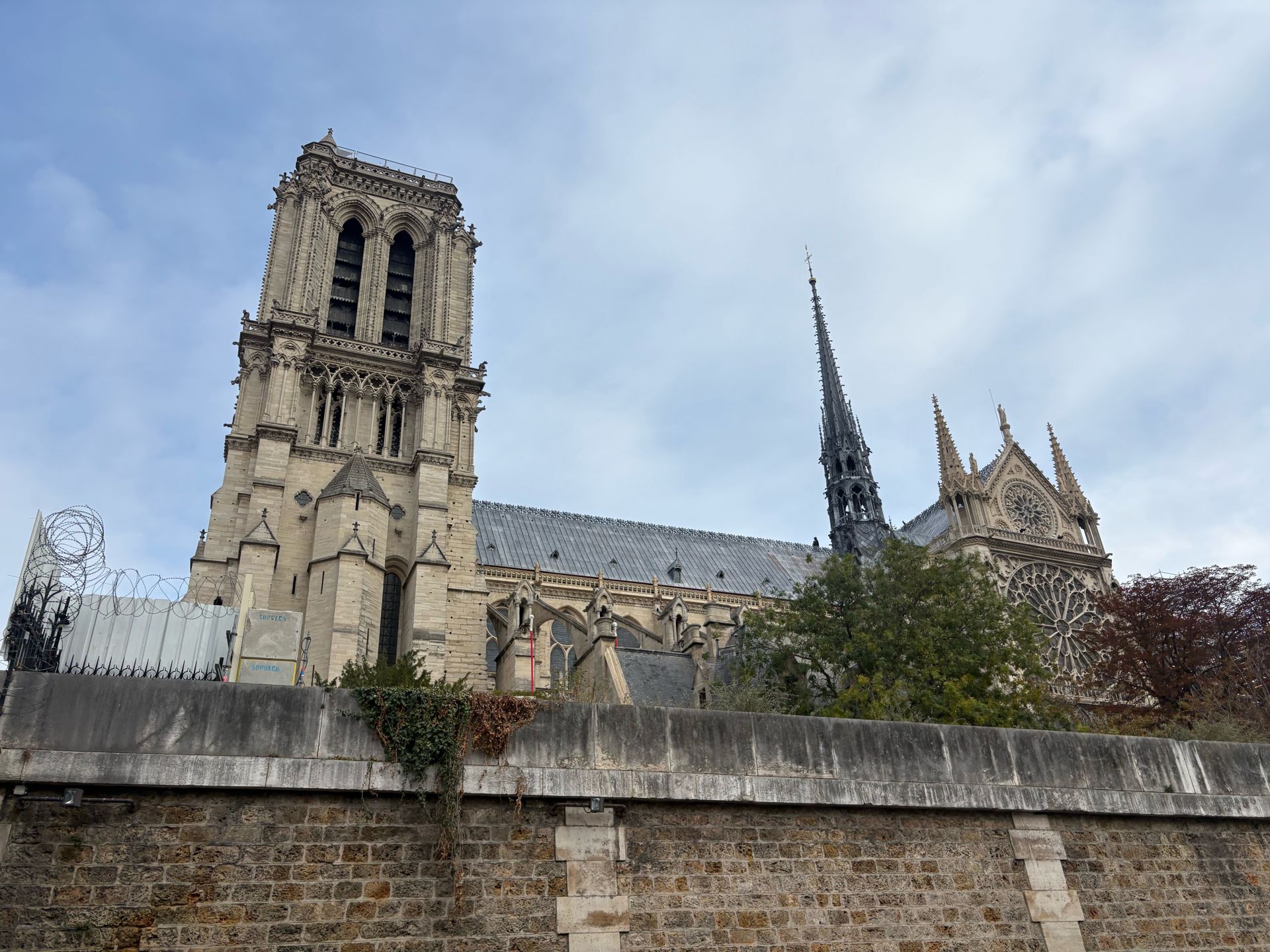
Past the Island
Down the side of the Île de la Cité, autumn had turned the trees on the quay orange and gold, in front of grand old stone buildings with slate roofs and pointed towers.
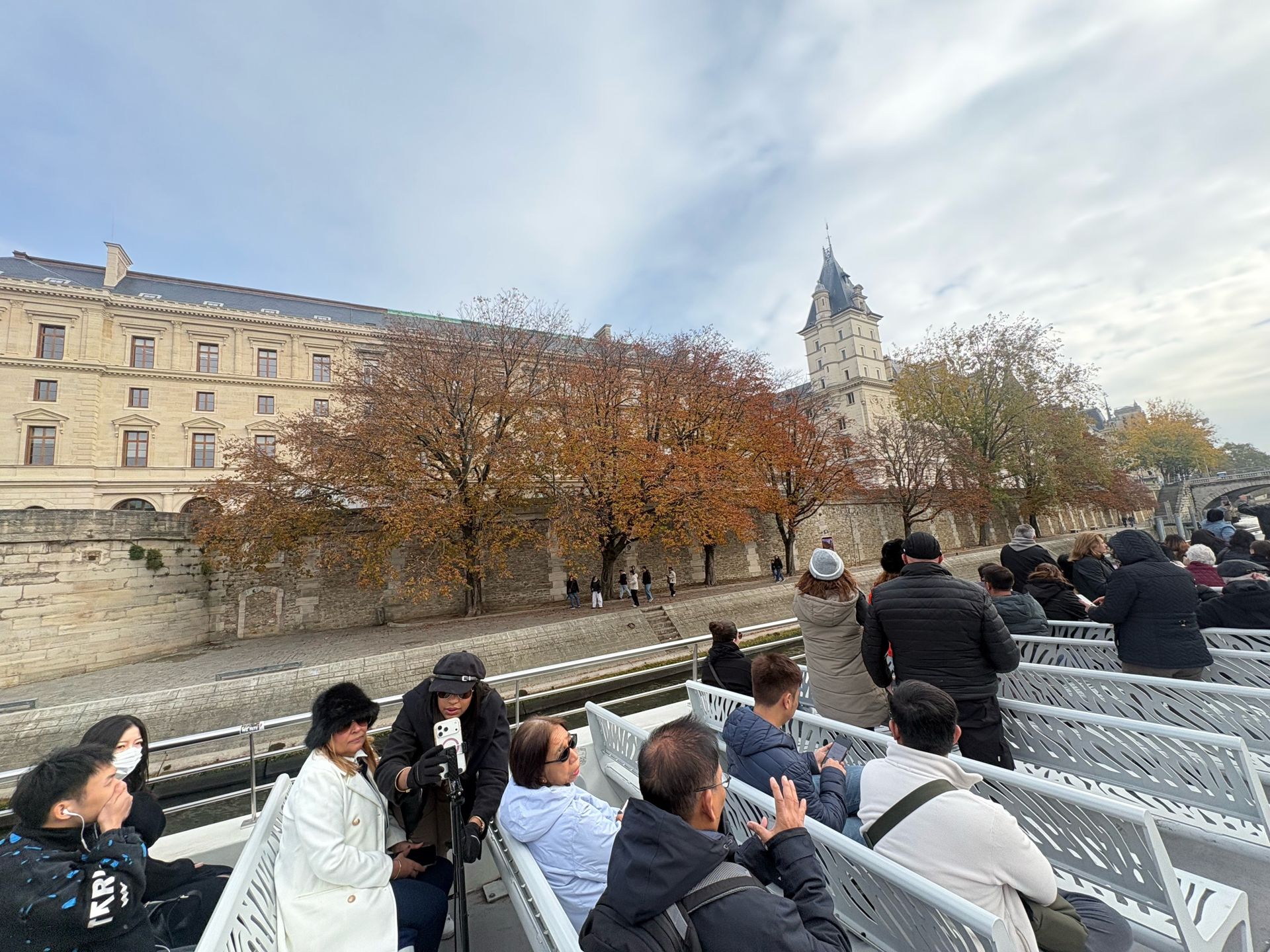
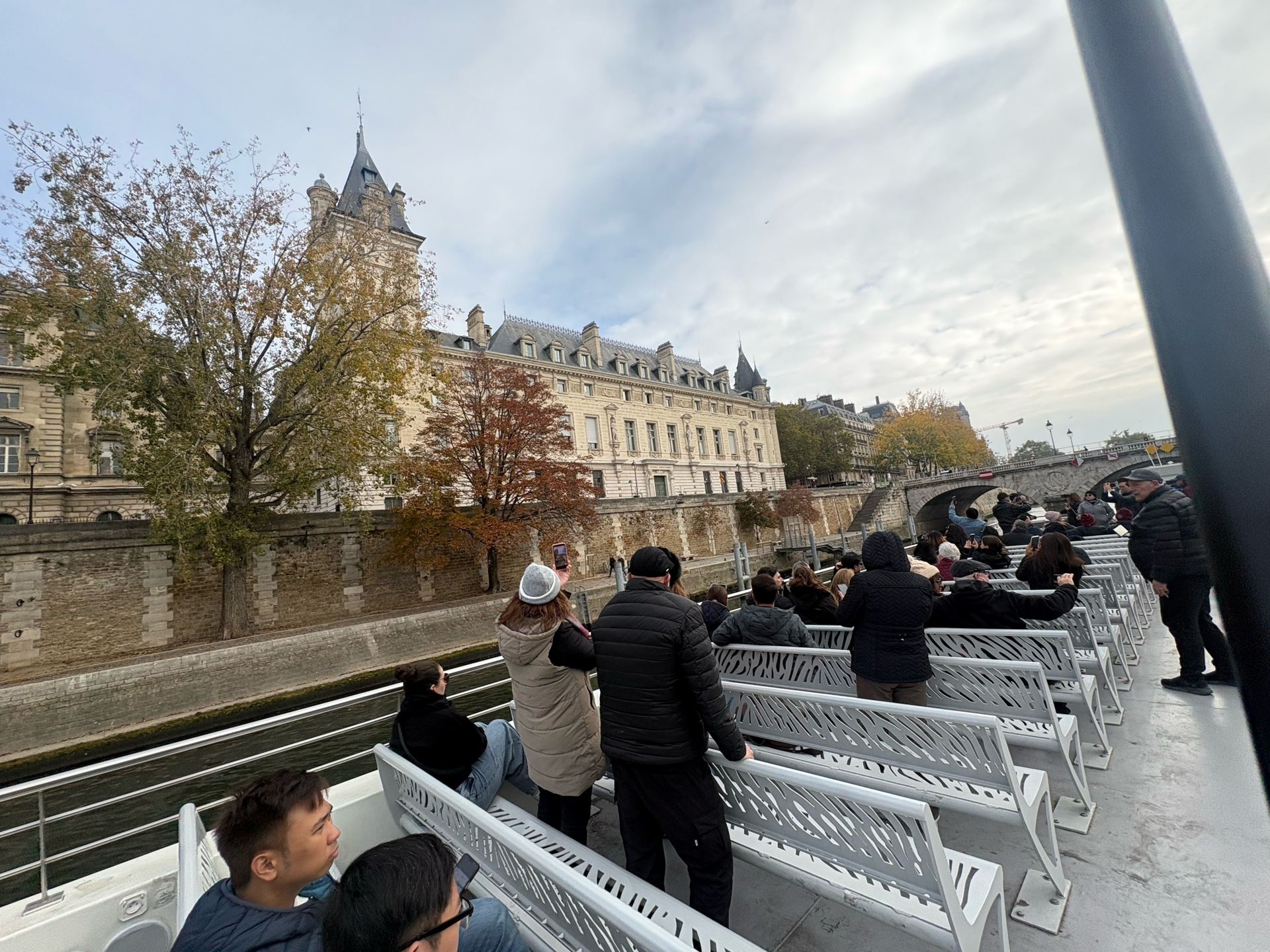
At the island’s tip, Henri IV keeps watch on horseback over the little Square du Vert-Galant, named after Henri IV’s nickname, le Vert Galant. His was the first public statue of a French king on horseback in Paris. The Revolution destroyed the original, so the one you see is its 1818 replacement. Even the ground under him is a remix: the square was once three tiny islets, joined to the Cité when the Pont Neuf was built.
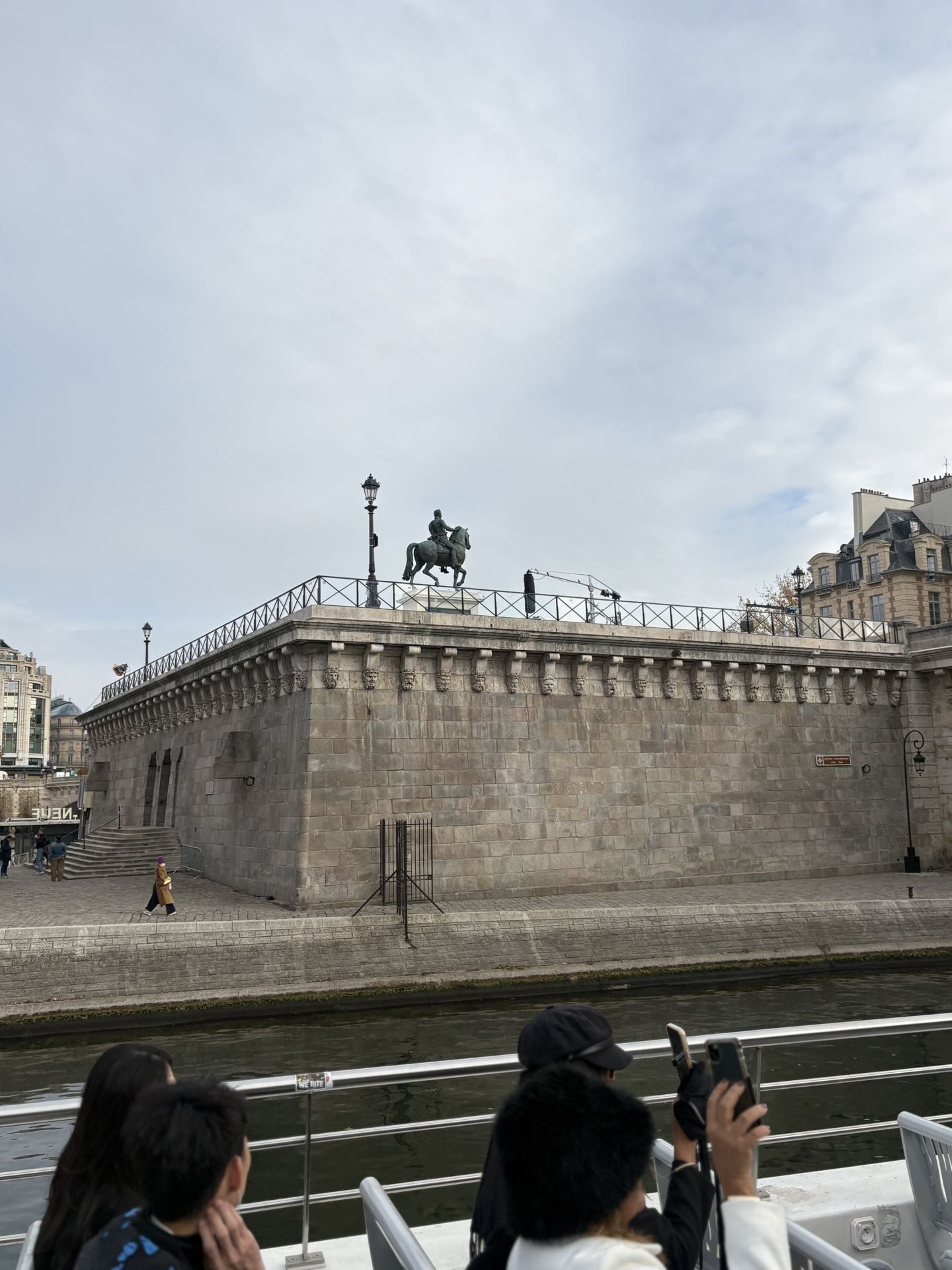
Right next to him: Pont Neuf, the “New Bridge”. It was begun in 1578 and opened in 1607, which makes it the oldest bridge in Paris. It was “new” because it was the first with no houses on it and the first with pavements. Look along the edges: hundreds of carved faces (381 by one count), all different, pulling faces at the river to keep evil spirits away.
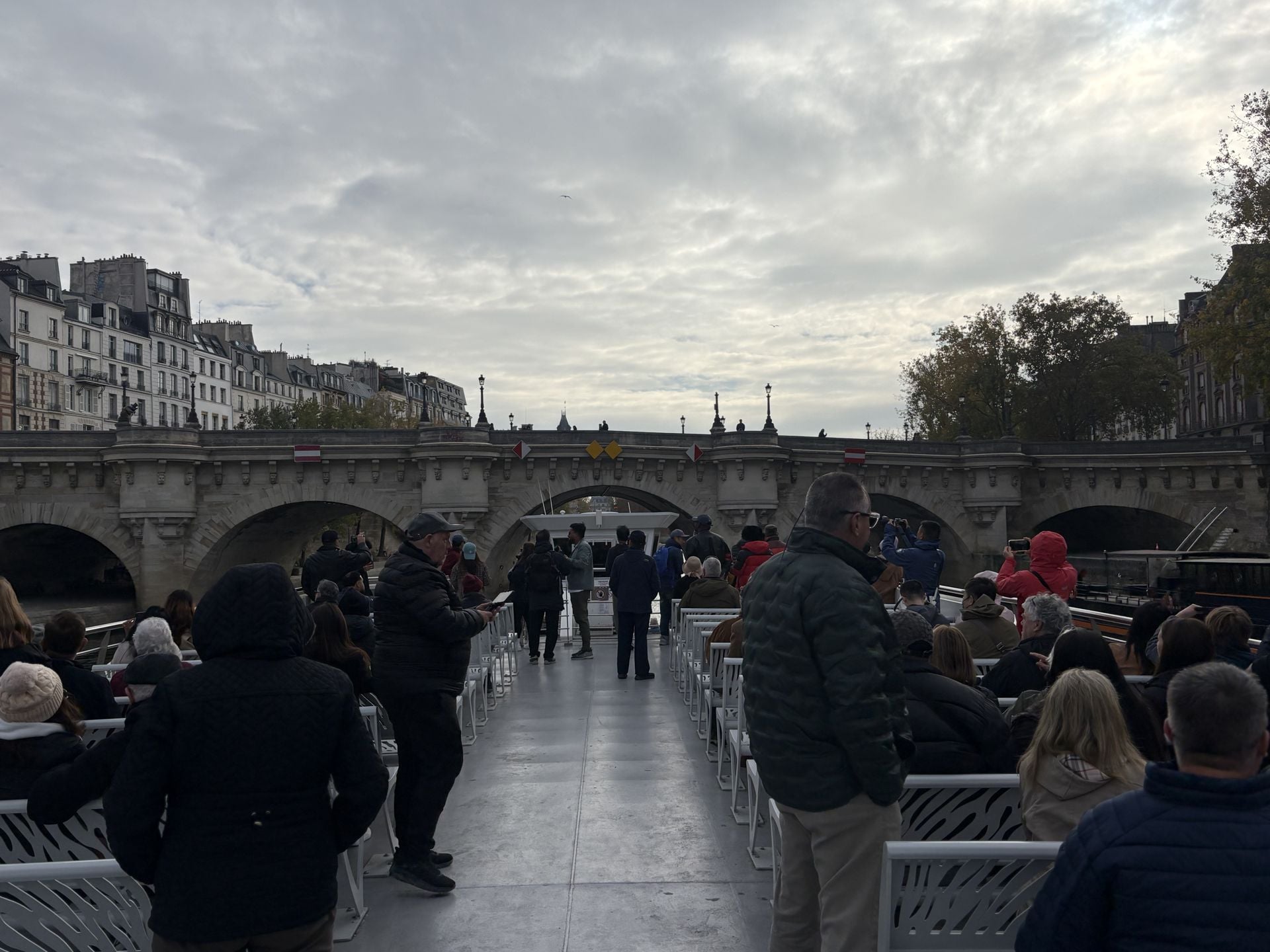
The Dome and the Footbridge
Then the Institut de France and its dome. It started life as a college founded by Cardinal Mazarin, and today it’s home of the Académie française and four other academies. The members are called “les Immortels”, after Richelieu’s motto “À l’immortalité”, though it’s the French language that’s meant to live forever, not the members. They also take their time: the dictionary’s 9th edition was only finished in 2024. The first edition came out in 1694.
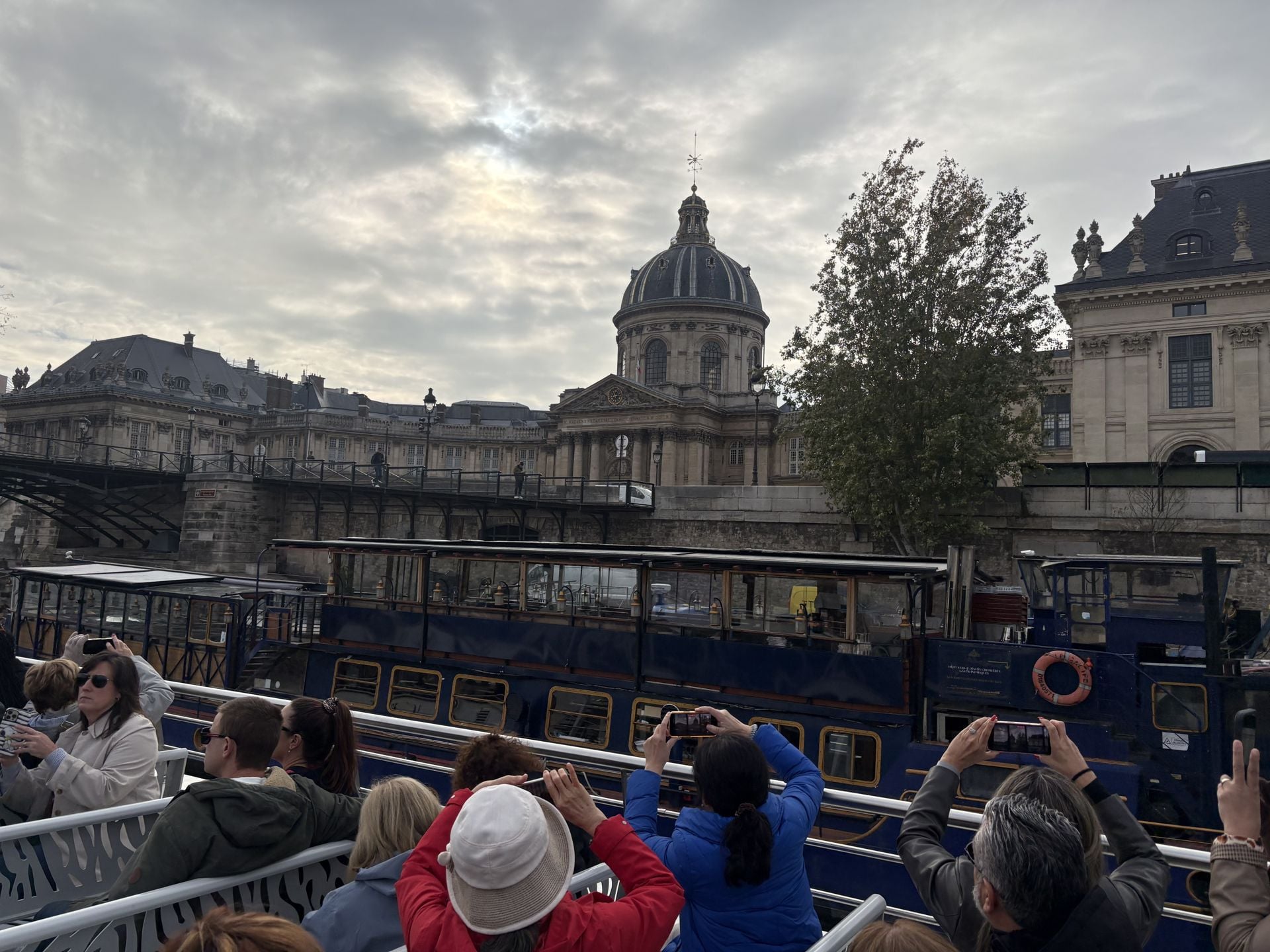
The metal footbridge right in front of it is the Pont des Arts, Paris’s first metal bridge, linking the Institut to the Louvre. For years it was covered in love locks, until part of the railing gave way under the weight. In 2015 the city took them all off, about 45 tonnes of them. That’s a lot of love. We went right under it.
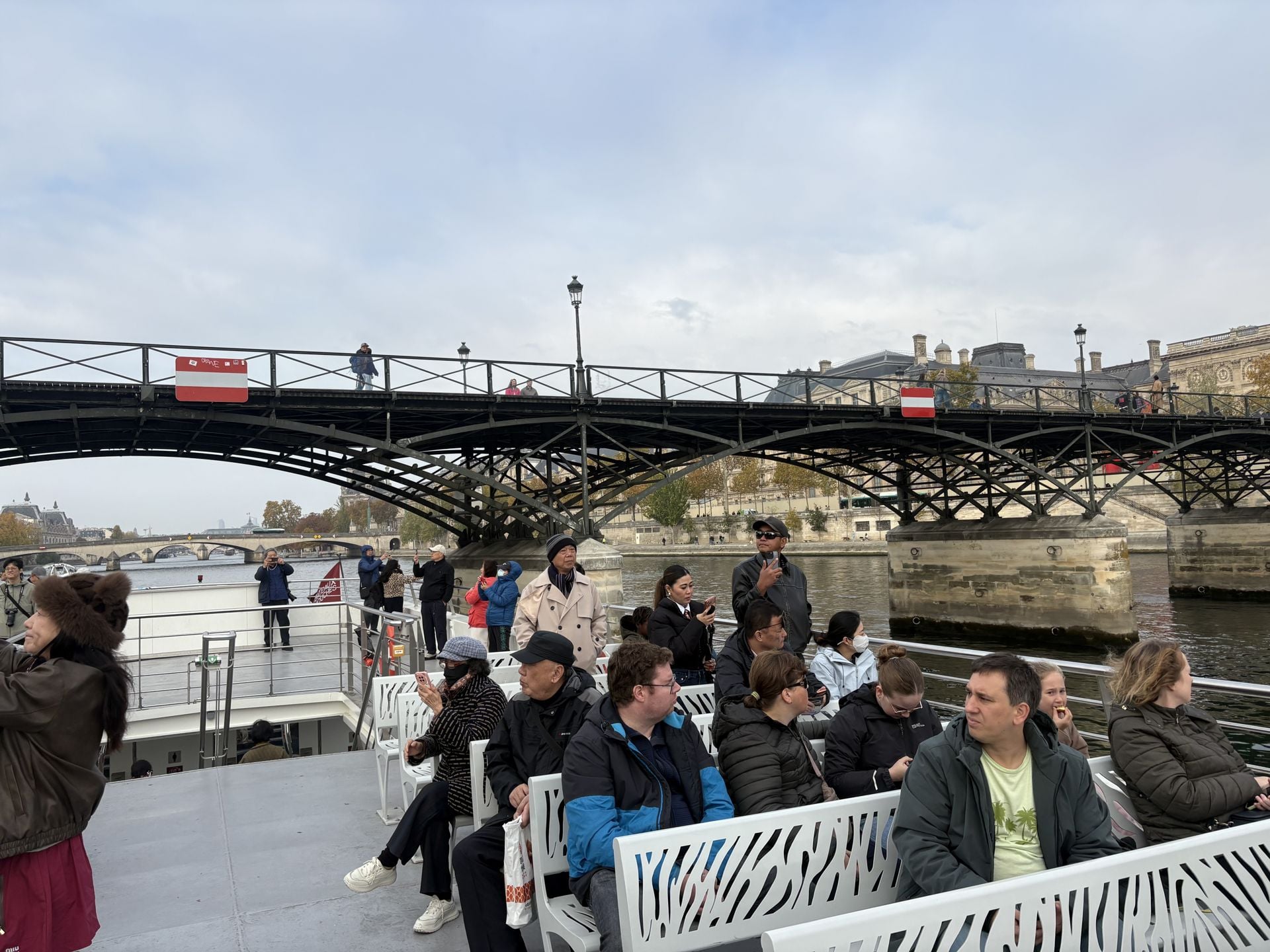
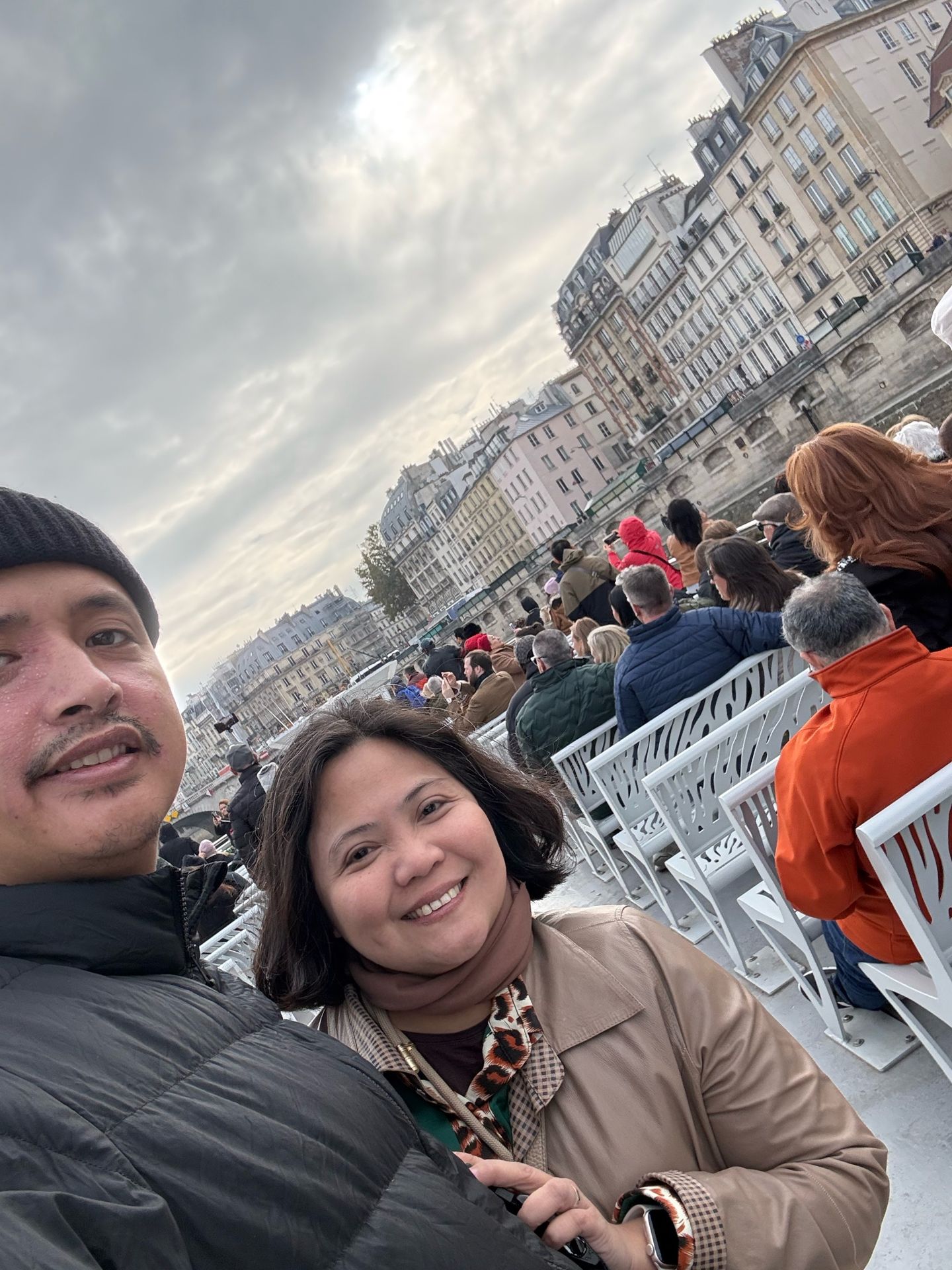
Somewhere along the way, one more selfie. Tall Paris buildings, white benches, still grey, still smiling.
Back Downriver
The Musée d’Orsay. Before it held paintings, it was a railway station, built in just two years for the 1900 World’s Fair. Its platforms later turned out too short for the newer, longer trains, and in the 1970s it was nearly knocked down for a hotel. Now it’s one of the great museums. Not bad for a station that was too short.
The Assemblée nationale (National Assembly). That’s France’s parliament. The temple-style columns facing the river were added under Napoleon.
Then it was back towards the Eiffel Tower, built for the 1889 World’s Fair and meant to be temporary, and the boat pulled in where we started.
The Quick Bits
- Who: Bateaux-Mouches, the sightseeing cruise.
- Where: the Bateaux-Mouches pier on the Port de la Conférence, right bank, at Pont de l’Alma.
- How long? About an hour (the official site says approximately 1 hour; Paris’s tourist office says about 1 hour 10).
- Route: up the Seine past the Louvre and the Conciergerie towards Notre-Dame, a turn near the Arab World Institute, then back past the Musée d’Orsay and the National Assembly towards the Eiffel Tower. The captain may change the route depending on the river level.
- Where does it end? Right back where it started. No “where are we now?” moment, which, in Paris, is rare.
- Seats: we sat on the open top deck. Dress for the weather; it’s breezy up there in autumn.
- Commentary: audio commentary in several languages (we spotted an audio-guide QR sign at the entrance).
If you’ve already done the tower, you’ll know Paris loves to show off. Our Eiffel Tower night lights post has the sparkle, and our Eiffel Tower visit post has the glass floor, for anyone whose knees have recovered.
Getting There
- Metro: Line 9 to Alma-Marceau, the closest stop. Line 1 to Franklin D. Roosevelt also works.
- RER C: to Pont de l’Alma, on the other side of the bridge.
- Bus: several lines stop nearby, including 42, 63, 72, 80 and 92.
New to the metro? Our Paris metro guide for first-timers covers tickets, the phone-tap method and how not to get lost changing lines.
After the Boat: Pick Your Paris
The cruise drops you back where you began, so the rest of the day is yours. Our guide’s options:
- Stay close: hang around the Eiffel Tower or the Champs-Élysées.
- Go shopping (or “just looking”): take the bus towards the Louvre, Galeries Lafayette and the perfume shops.
- Go see Notre-Dame.
Heading back to the H4 Wyndham Paris Pleyel afterwards? Lines 13 and 14 both stop near the hotel; the metro guide has the details.
FAQ
How long is the Bateaux-Mouches cruise? About an hour. The official site says approximately 1 hour, and Paris’s tourist office says about 1 hour 10 minutes.
Where does Bateaux-Mouches leave from? The Port de la Conférence, on the right bank at Pont de l’Alma. The boat comes back to the same pier.
What’s the nearest metro? Alma-Marceau on Line 9. RER C stops at Pont de l’Alma.
Is there commentary? Yes, audio commentary in several languages.
Is it worth doing on a grey day? We went under an overcast autumn sky on the open top deck and still had the tower, the bridges, Notre-Dame and a dinosaur. Paris doesn’t need the sun to show off.
Is the Bateaux-Mouches cruise good for history? Yes. In about an hour you pass the oldest bridge in Paris (the Pont Neuf, despite its name), the Conciergerie where Marie-Antoinette was held, the rebuilt Notre-Dame and the Institut de France, home of the Académie française.
Can you see Notre-Dame from the boat? Yes, up close. On the way back the boat takes the small arm of the Seine between the Île de la Cité and the Left Bank, right past the cathedral and its rebuilt spire.
Where should you sit? We loved the open top deck for photos. On a cold or grey day, bring a warm layer.